


Aristolochic acid
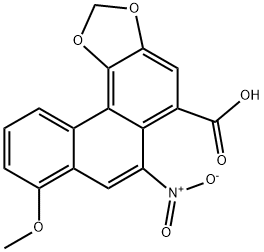
- CAS No.
- 313-67-7
- Chemical Name:
- Aristolochic acid
- Synonyms
- ARISTOLOCHIC ACID I;ARISTOLOCHIC ACID A;Aristolochic acid Ⅰ;tardolyt;Aristolochic;Aristolochic acid Ⅲ;Isoaristolochic acid;Aristolochic acid I,TR 1736;3,4-methylenedioxy-8-methoxy-10-nitro-1-phenanthrenecarboxylicacid;TR 1736
- CBNumber:
- CB8481548
- Molecular Formula:
- C17H11NO7
- Molecular Weight:
- 341.27
- MDL Number:
- MFCD00004996
- MOL File:
- 313-67-7.mol
- MSDS File:
- SDS
- TDS File:
- TDS
| Product description | Number | Pack Size | Price |
| Aristolochia European Pharmacopoeia (EP) Reference Standard | Y0001323 | 140 mg | $175 |
| Aristolochic acid I powder | A5512 | 25mg | $105 |
| Aristolochic acid I European Pharmacopoeia (EP) Reference Standard | Y0001185 | 11 mg | $254 |
| Aristolochic acid I powder | A5512 | 100mg | $347 |
| Aristolochic Acid | A3599 | 100MG | $214 |
| More product size | |||
| Melting point | 260 °C |
|---|---|
| Boiling point | 476.92°C (rough estimate) |
| Density | 1.3162 (rough estimate) |
| refractive index | 1.4500 (estimate) |
| storage temp. | 2-8°C |
| solubility | DMSO: soluble |
| pka | 2.99±0.20(Predicted) |
| form | powder |
| color | yellow |
| Major Application | pharmaceutical (small molecule) |
| InChI | InChI=1S/C17H11NO7/c1-23-12-4-2-3-8-9(12)5-11(18(21)22)14-10(17(19)20)6-13-16(15(8)14)25-7-24-13/h2-6H,7H2,1H3,(H,19,20) |
| InChIKey | LIDQMWRBMLSXLL-UHFFFAOYSA-N |
| SMILES | O1C2=C3C(=C(C(O)=O)C=C2OC1)C([N+]([O-])=O)=CC1C3=CC=CC=1OC |
| CAS DataBase Reference | 313-67-7(CAS DataBase Reference) |
| EWG's Food Scores | 1 |
| FDA UNII | 94218WFP5T |
| IARC | 1 (Vol. 82, 100A) 2012, 1 (Vol. 82, 100A) 2012 |
| UNSPSC Code | 41116107 |
| NACRES | NA.77 |
SAFETY
Risk and Safety Statements
| Symbol(GHS) |   GHS06,GHS08 |
|||||||||
|---|---|---|---|---|---|---|---|---|---|---|
| Signal word | Danger | |||||||||
| Hazard statements | H301-H340-H350 | |||||||||
| Precautionary statements | P202-P264-P270-P280-P301+P310-P405 | |||||||||
| Hazard Codes | T | |||||||||
| Risk Statements | 25-68-36/37/38-23/24/25-45 | |||||||||
| Safety Statements | 7-35-45-36/37/39-26-53 | |||||||||
| RIDADR | UN 1544 6.1/PG 3 | |||||||||
| WGK Germany | 3 | |||||||||
| RTECS | CF3325000 | |||||||||
| HazardClass | 6.1(b) | |||||||||
| PackingGroup | III | |||||||||
| HS Code | 29329990 | |||||||||
| Storage Class | 6.1C - Combustible acute toxic Cat.3 toxic compounds or compounds which causing chronic effects |
|||||||||
| Hazard Classifications | Acute Tox. 3 Oral Carc. 1A Muta. 1B |
|||||||||
| Toxicity | LD50 in male, female mice, male, female rats (mg/kg): 38.4, 70.1, 82.5, 74.0 i.v.; 55.9, 106.1, 203.4, 183.9 orally (Mengs) | |||||||||
| NFPA 704 |
|
Aristolochic acid price More Price(88)
| Manufacturer | Product number | Product description | CAS number | Packaging | Price | Updated | Buy |
|---|---|---|---|---|---|---|---|
| Sigma-Aldrich | Y0001323 | Aristolochia European Pharmacopoeia (EP) Reference Standard | 313-67-7 | 140 mg | $175 | 2026-04-30 | Buy |
| Sigma-Aldrich | A5512 | Aristolochic acid I powder | 313-67-7 | 25mg | $105 | 2026-04-30 | Buy |
| Sigma-Aldrich | Y0001185 | Aristolochic acid I European Pharmacopoeia (EP) Reference Standard | 313-67-7 | 11 mg | $254 | 2026-04-30 | Buy |
| Sigma-Aldrich | A5512 | Aristolochic acid I powder | 313-67-7 | 100mg | $347 | 2026-04-30 | Buy |
| TCI Chemical | A3599 | Aristolochic Acid | 313-67-7 | 100MG | $214 | 2026-04-30 | Buy |
Aristolochic acid Chemical Properties,Uses,Production
Description
Aristolochic acid first appeared in Chinese medicine in the fifth century AD, while it was used to treat kidney and urinary diseases, as well as gout, snakebites, and a variety of other ailments. In many of these cases, aristolochic acid was just one of the main components of the salves. In the first century, aristolochic acid was first described as a composition of ingested medicine to treat symptoms such as asthma, hiccups, pains, and spasms.
Chemical Properties
Shiny brown leaflets or a yellow or white powder.
Physical properties
Appearance: brown sheet crystal or yellow powder. Solubility: practically insoluble in water and soluble in ethanol, chloroform, ethyl ether, acetone, glacial acetic acid, and aniline. Melting point: 260–265°C (500–509°F; 533–538K).
History
At a clinic in Brussels, Belgium, a group of women who had all taken the same weight loss supplement, Aristolochia fangchi, which contained aristolochic acid, was first diagnosed with aristolochic acid poisoning. Balkan endemic nephropathy (BEN) was later found to be also the result of aristolochic acid (AA) consumption. Balkan endemic nephropathy is likely caused by low-level AA exposure, possibly from the contamination of wheat flour seeds by Aristolochia clematitis. BEN falls under the umbrella of what is now known as aristolochic acid nephropathy, the prevalent symptom of AA poisoning .
Uses
PLA2 inhibitor
Uses
Aristolochic acids occur in Aristolochiaceae and in butterflies feeding on these plants. One of a group of fourteen known, substituted 1-phenanthrenecarboxylic acids
Uses
Aristolochic acid I is a potent phospholipase A2 inhibitor. Aristolochic acid I induces tumor formation in rat kidneys and apoptosis in human renal proximal tubular epithelial cells.
Definition
ChEBI: A monocarboxylic acid that is phenanthrene-1-carboxylic acid that is substituted by a methylenedioxy group at the 3,4 positions, by a methoxy group at position 8, and by a nitro group at position 10. It is the most abundant of the aristolochic acids and is found in almost all Aristolochia (birthworts or pipevines) species. It has been tried in a number of treatments for inflammatory disorders, mainly in Chinese and folk medicine. However, there is concern over their use as aristolochic acid is b th carcinogenic and nephrotoxic.
Indications
Due to the widely associated kidney problems and urothelial cancers, the FDA has issued warnings regarding consumption of AA-containing supplements.
brand name
Acidum aristolchicum;Descresepet;Fago-araxin;Fluocinova;Predno-facilus haemota.
World Health Organization (WHO)
Extracts of aristolochiaceae have traditionally been used as a bitter for which a broad range of therapeutic effects has been claimed. Aristolochic acid is claimed to promote phagocytosis and to have immunostimulant activity. However, in 1981, a three-month toxicity study in rats revealed the carcinogenic potential of aristolochic acid and preparations containing this substance have since been withdrawn in several countries.
General Description
This substance is a primary reference substance with assigned absolute purity (considering chromatographic purity, water, residual solvents, inorganic impurities). The exact value can be found on the certificate. Produced by PhytoLab GmbH & Co. KG
Biochem/physiol Actions
Potent phospholipase A2 inhibitor, including calcium ionophore-induced phospholipase A2 activity in neutrophils. Kidney tumor initiator in experimental animal model.
Pharmacology
In 1992, some cases of women present with a rapidly progressive renal failure after having a slimming regimen including powdered extracts of Chinese herbal preparations. This outbreak of renal failure eventually resulted in about 100 cases in 1998, 70% of them being in end-stage renal disease (ESRD) . Recent research has confirmed that the main reason leading to renal injury is aristolochic acid found in many Chinese herbs . Aristolochic acid, a potent human carcinogen from Aristolochia plants, is associated with the incidence of urothelial carcinoma in the upper urinary tract (UUC). After the metabolic activation, aristolochic acid reacted with DNA to form aristolactam (AL)-DNA adducts. Mainly pathological changes are in renal cortex, where they serve as a specific biomarker, and are also found in urothelium, where they lead to a unique mutational signature in the TP53 tumorsuppressor gene. The conclusion is that exposure to aristolochic acid gives rise to the incidence of UUC, a finding with significant implications for the global public health .
Clinical Use
Aristolochia species are nephrotoxic and carcinogenic, and FDA has issued warnings regarding consumption of AA-containing supplements.
Safety Profile
Confirmed carcinogen. Poison by ingestion, intraperitoneal, and intravenous routes. Mutation data reported. When heated to decomposition it emits toxic fumes of NO,. Potentially Toxic Chemicals: April 1982." Vol. 5 No. 1: The Ministry of Health of the Federal Republic of Germany has withdrawn from the national market drugs containing aristolochic acid. The decision resulted from the demonstration of a carcinogenic potential in a three-month ingestion toxicity study undertaken in rats. Aristolochic acid is claimed to promote phagocytosis and to have immunostimulant activity. A growth-inhibiting effect on experimentally induced tumors has been described, but this effect has not been shown to have any clinical relevance. Extracts of species of Aristolochiacea have tradtionally been used as a bitter, and a broad range of therapeutic effects has been claimed.
Potential Exposure
Aristolochic acids are alkaloids used primarily as a chemical intermediate for pharmaceuticals, lab chemicals, herbal extract, drug.
Shipping
UN1544 Alkaloids, solid, n.o.s. or Alkaloid salts, solid, n.o.s. poisonous, Hazard Class: 6.1; Labels: 6.1- Poisonous materials, Technical Name Required. PG III.
Incompatibilities
Compounds of the carboxyl group react with all bases, both inorganic and organic (i.e., amines) releasing substantial heat, water and a salt that may be harmful. Incompatible with oxidizers (chlorates, nitrates, peroxides, permanganates, perchlorates, chlorine, bromine, fluorine, etc.); contact may cause fires or explosions. Keep away from alkaline materials, strong bases, strong acids, oxoacids, epoxides.
Waste Disposal
It is inappropriate and possibly dangerous to the environment to dispose of expired or waste drugs and pharmaceuticals by flushing them down the toilet or discarding them to the trash. Household quantities of expired or waste pharmaceuticals may be mixed with wet cat litter or coffee grounds, double-bagged in plastic, discard in trash. Larger quantities shall carefully take into consideration applicable DEA, EPA, and FDA regulations. If possible return the pharmaceutical to the manufacturer for proper disposal being careful to properly label and securely package the material. Alternatively, the waste pharmaceutical shall be labeled, securely packaged and transported by a state licensed medical waste contractor to dispose by burial in a licensed hazardous or toxic waste landfill or incinerator. All federal, state, and local environmental regulations must be observed.
Aristolochic acid Preparation Products And Raw materials
Raw materials
Preparation Products
| Supplier | Tel | Country | ProdList | Advantage | |
|---|---|---|---|---|---|
| Chengdu GLP biotechnology Co Ltd | 028-87075086 13350802083 | scglp@glp-china.com | CHINA | 1824 | 58 |
| Henan Tianfu Chemical Co.,Ltd. | +86-0371-55170693 +86-19937530512 | info@tianfuchem.com | China | 21585 | 55 |
| Shanghai Zheyan Biotech Co., Ltd. | 18017610038 | zheyansh@163.com | CHINA | 3619 | 58 |
| career henan chemical co | +86-0371-86658258 | sales@coreychem.com | China | 29812 | 58 |
| SHANDONG ZHI SHANG CHEMICAL CO.LTD | 0531-68652808 18953170293 | sales@sdzschem.com | China | 2921 | 58 |
| Chengdu Biopurify Phytochemicals Ltd. | +86-28-82633860; +86-18080483897 | sales@biopurify.com | China | 4616 | 58 |
| Nanjing Dolon Biotechnology Co.,Ltd. | 18905173768 | 52513593@qq.com | CHINA | 2972 | 58 |
| CONIER CHEM AND PHARMA LIMITED | sales@conier.com | China | 49979 | 58 | |
| Wuhan ChemNorm Biotech Co.,Ltd. | +86-27-8439 4403 18971486879 | sales@chemnorm.com | CHINA | 2935 | 58 |
| TargetMol Chemicals Inc. | +1-781-999-5354; +1-00000000000 | marketing@targetmol.com | United States | 32468 | 58 |
View Lastest Price from Aristolochic acid manufacturers
| Image | Update time | Product | Price | Min. Order | Purity | Supply Ability | Manufacturer | |
|---|---|---|---|---|---|---|---|---|
 |
2026-08-02 | Aristolochic acid
313-67-7
|
0.99 | RongNa Biotechnology Co.,Ltd | ||||
 |
2026-07-15 | Aristolochic acid A
313-67-7
|
$31.00-76.00 | 99.95% | 10g | TargetMol Chemicals Inc. | ||
 |
2023-02-13 | Aristolochic acid
313-67-7
|
$110.00 | 1kg | 99% | 100MT | Hebei baicao biology science and technology co., ltd |
-
- Aristolochic acid
313-67-7
- 0.99
- RongNa Biotechnology Co.,Ltd
-
- Aristolochic acid A
313-67-7
- $31.00-76.00
- 99.95%
- TargetMol Chemicals Inc.
-
- Aristolochic acid
313-67-7
- $110.00
- 99%
- Hebei baicao biology science and technology co., ltd
