


?? ???
|
|
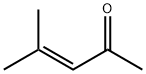
?? ??? ??
- ???
- −53 °C(lit.)
- ?? ?
- 129 °C(lit.)
- ??
- 0.858 g/mL at 25 °C(lit.)
- ???
- 10.5 hPa (20 °C)
- ???
- n
20/D 1.442(lit.)
- ???
- 87 °F
- ?? ??
- Store below +30°C.
- ???
- 30g/L
- ??? ??
- ??, ?? ?? ??
- ??
- ???
- Specific Gravity
- 0.86
- ??
- ??; ??; ? ??.
- ????
- 1.4-10.1%(V)
- ?? ??
- ??
- ???? ??
- synthetic
- ???
- 28g/L(20℃)
- ????
- 0.14 W/(m·K) at 25 ℃
- ??
- Cp(liquid): 2.17 J/(g·K), at 25℃
- Merck
- 14,5908
- JECFA Number
- 1131
- BRN
- 1361550
- Henry's Law Constant
- (x 10-6 atmm3/mol): 4.01 at 20 °C (approximate - calculated from water solubility and vapor pressure)
- Dielectric constant
- 15.4(20℃)
- ?? ??
- ACGIH:TLV-TWA 1 ppm
OSHA:PEL-TWA 25 ppm (100 mg/m3)
NIOSH:REL-TWA 10 ppm
- ???
- ???
- ?? ??
- ?? ? ?
- ??? ?? ??
- ??
- InChI
- 1S/C6H10O/c1-5(2)4-6(3)7/h4H,1-3H3
- InChIKey
- SHOJXDKTYKFBRD-UHFFFAOYSA-N
- SMILES
- C\C(C)=C\C(C)=O
- LogP
- 1.37 at 20℃
- CAS ??????
- 141-79-7(CAS DataBase Reference)
??
- ?? ? ?? ??
- ?? ? ???? ?? (GHS)
| ??? ?? | Xn | ||
|---|---|---|---|
| ?? ???? ?? | 10-20/21/22-36/37/38 | ||
| ????? | 25 | ||
| OEB | A | ||
| OEL | TWA: 10 ppm (40 mg/m3) | ||
| ????(UN No.) | UN 1229 | ||
| WGK ?? | 1 | ||
| RTECS ?? | SB4200000 | ||
| ?? ?? ?? | 344 °C | ||
| TSCA | TSCA listed | ||
| HS ?? | 2914 19 90 | ||
| ?? ?? | 3 | ||
| ???? | III | ||
| ???? ??? | 3 - Flammable liquids | ||
| Hazard Classifications | Acute Tox. 3 Inhalation Acute Tox. 4 Dermal Acute Tox. 4 Oral Eye Irrit. 2 Flam. Liq. 3 Skin Irrit. 2 STOT SE 3 |
||
| ?? ?? ??? | 141-79-7(Hazardous Substances Data) | ||
| ?? | LD50 in mice (mg/kg): 710 ±85 intragastric; LC50 in mice (2 hr), rats (4 hr) (mg/m3): 10000 ±270, 9000 ±600 (Ismerov) | ||
| IDLA | 1,400 ppm [10% LEL] | ||
| ???? ?? | KE-24767 |


?? ??? C??? ??, ??, ??
??
The commercial grade of 4-methyl-3-penten-2-one exhibits an unpleasant grassy-green or pungent, acrylic odor. The pure material has a pleasant, honey-like odor. This substance may be prepared by reacting acetone or diacetone alcohol with iodine or other dehydrating agent; by condensation of acetone over sulfonated polystyrene-divinylbenzene resin used as an ion exchange catalyst.??? ??
Mesityl oxide is a clear, pale yellow, or colorless liquid with a strong peppermint odor. The odor threshold is 0.05 ppm.??? ??
Clear, pale yellow liquid with a strong, peppermint, or honey-like odor. Experimentally determined detection and recognition odor threshold concentrations were 70 μg/m3 (17 ppbv) and 200 μg/m3 (50 ppbv), respectively (Hellman and Small, 1974).??
Reported found in orange juice, baked potato, bell pepper, sauerkraut, tomato, crisp bread, parmesan cheese, milk, chicken fat, hop oil, rum, coffee, tea, peanut, passion fruit, mushroom, tamarind, prickly pear, buckwheat, basil, elder flower, rosemary, shrimp, nectarine, clam and maté??
4-Methyl-4-penten-2-one is used to a small extent as an intermediate in synthesis. Most of it is converted to 4-methyl-2-pentanone by selective hydrogenation. Although 4-methyl-2- pentanone has excellent solvent properties for nitrocellulose, cellulose esters and ethers, copolymers of vinyl chloride – vinyl acetate and other synthetic resins, as well as natural and synthetic rubber, its use as a solvent is limited as a result of its toxicity and chemical instability. The fraction of 4-methyl-4-penten-2-one permitted in solvent systems has been set at 5 vol% (Rule 66 of the Los Angeles, California, Air Pollution Control District). Some of the numerous possible reactions that mesityl oxide may undergo have been used for the synthesis of products such as Budralazine, an antihypertensive agent.?? ??
4-Methyl-4-penten-2-one is the precursor of methyl isobutyl ketone (see Section 2.2) and can be produced from acetone in a single- or a two-step process . Pure mesityl oxide is obtained by azeotropic distillation of the crude watercontaining product. Subsequent purification by removal of the accompanying impurities, such as mesitylene and phorone [504-20-1], is effected by distillation.?? ??
Mesityl oxide appears as a colorless, oily liquid with a pungent honey-like odor. Flash point 87 °F. Less dense than water and slightly soluble in water. Vapors heavier than air. Used in paint removers, as a solvent for plastics, and as an insect repellent.??? ?? ??
Highly flammable. Slightly soluble in water?? ???
Mixing MESITYL OXIDE in equal molar proportions with any of the following substances in a closed container caused the temperature and pressure to increase: 2-aminoethanol, chlorosulfonic acid, ethylene diamine, nitric acid, oleum, or sulfuric acid [NFPA 1991].???
Flammable, moderate fire risk. Toxic by ingestion, inhalation, and skin absorption. Eye and upper respiratory tract irritant, central nervous system impairment.????
Mesityl oxide is a moderately toxic substance, more toxic than the saturated ketones.Inhalation of its vapors can cause irritationto the eyes, skin, and mucous membranes. Inhumans, the irritation effect on the eyes andnose are reported to be 25 and 50 ppm. Athigh concentrations narcosis can result. Otherthan narcosis, prolonged exposure to highconcentrations can injure the lungs, liver, and kidney. A concentration of 2500 ppm waslethal to rats.LD50 value, oral (rats): 1120 mg/kg.
????
Behavior in Fire: Vapor is heavier than air and may travel a considerable distance to a source of ignition and flash back.Safety Profile
Poison by intraperitoneal route. Moderately toxic by ingestion. Mildly toxic by inhalation and skin contact. Human systemic effects by inhalation: conjunctiva irritation. This compound is highly irritating to all tissues on contact; its vapors also are irritating. High concentrations are narcotic. It is readdy absorbed through intact skin. Single exposures tend to indicate that ths ketone has greater acute and narcotic action than isophorone. It can have harmful effects upon the hdneys and liver, and may damage the eyes and lungs to a serious degree. Prolonged exposure can injure liver, kidneys, and lungs. It can cause opaque cornea, keratoconus, and extensive necrosis of cornea. Dangerous fire hazard when exposed to heat, sparks, or flame; can react with oxidzing materials. Reacts violently with 2-amino ethanol, chlorosulfonic acid, ethylene diamine, HNO3, oleum, H2SO4. An insect repellent. To fight fire, use alcohol foam, CO2, dry chemical. When heated to decomposition it emits acrid smoke and irritating fumes. See also KETONES.??? ??
Mesityl oxide is used as a solvent for cellulose esters and ethers and other resins in lacquers and inks. It is used in paint and varnish removers and as an insect repellent?? ??
UN1229 Mesitly oxide, Hazard Class: 3; Labels: 3-Flammable liquid.Purification Methods
Purify it by distillation, preferably in a vacuum or via the semicarbazone (m 165o) which is decomposed to pure ketone. The 2,4-dinitrophenylhydrazone (m 205-206o) crystallises from EtOH. [Johnson J Am Chem Soc 73 5888 1951, Johnson J Am Chem Soc 75 2720 1953, Erskine & Waight J Chem Soc 3425 1960, Beilstein 1 H 736, 1 I 382, 1 II 793, 1 III 2995, 1 IV 3471.]? ???
May form explosive mixture with air. May be able to form explosive peroxides. May react violently with nitric acid; aliphatic amines; alkanolamines, 2- aminoethanol, ethylene diamine; chlorosulfonic acid; oleum (fuming sulfuric acid). Not compatible with oxidizers, strong acids; strong bases; reducing agents; halogens. Dissolves some forms of plastics, resins and rubber. Attacks copper.??? ??
Dissolve or mix the material with a combustible solvent and burn in a chemical incinerator equipped with an afterburner and scrubber. All federal, state, and local environmental regulations must be observed.?? ??? ?? ?? ? ???
???
???????
???????
4-Methyl-3-penten-2-one oxime
2-Pentanone, 4-chloro-4-methyl-
3,4-???-4-????-2-?
2-Heptanone, 4-hydroxy-
4-??-4-(?????????)-2-???
4-METHYL-3-PENTEN-2-OL
????
p-????
Cyclopropane, 2-bromo-1,1-dimethyl-3-methylene-
?? ??
?? ??? ?? ??
???( 319)?? ??
| ??? | ?? | ??? | ?? | ?? ? | ?? |
|---|---|---|---|---|---|
| Shanxi Naipu Import and Export Co.,Ltd | +86-13734021967 13734021967 |
kaia@neputrading.com | China | 991 | 58 |
| Hebei Chuanghai Biotechnology Co,.LTD | +86-86-13131129325 |
sales1@chuanghaibio.com | China | 5218 | 58 |
| Henan Tianfu Chemical Co.,Ltd. | +86-0371-55170693 +86-19937530512 |
info@tianfuchem.com | China | 21531 | 55 |
| Shanghai Time Chemicals CO., Ltd. | +86-021-57951555 +8618017249410 |
jack.li@time-chemicals.com | China | 1796 | 55 |
| career henan chemical co | +86-0371-86658258 |
sales@coreychem.com | China | 29766 | 58 |
| Jinan Finer Chemical Co., Ltd | +86-531-88989536 +86-15508631887 |
sales@finerchem.com | China | 2949 | 58 |
| Henan Xiangtong Chemical Co., Ltd. | 86-371-61312303 |
info@hnxtchem.com | CHINA | 291 | 58 |
| Standardpharm Co. Ltd. | 86-714-3992388 |
overseasales1@yongstandards.com | United States | 14320 | 58 |
| CONIER CHEM AND PHARMA LIMITED | |
sales@conier.com | China | 49906 | 58 |
| Antai Fine Chemical Technology Co.,Limited | 18503026267 |
info@antaichem.com | CHINA | 9631 | 58 |