


L-(+)-?????
|
|
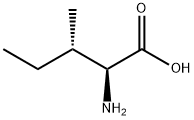
L-(+)-????? ??
- ???
- 288 °C (dec.) (lit.)
- ?? ?
- 225.8±23.0 °C(Predicted)
- ??
- 41 º (c=4, 6N HCl)
- ??
- 1.2930 (estimate)
- ?? ??
- 470kg/m3
- ???
- 40.5 ° (C=4, 6mol/L HCl)
- FEMA
- 4675 | L-ISOLEUCINE
- ???
- 168-170°C
- ?? ??
- Store below +30°C.
- ???
- 1M HCl: 50mg/mL
- ??? ??
- ??
- ?? ?? (pKa)
- 2.32, 9.76(at 25℃)
- ??
- ???? ?????
- ??
- ?? ??
- ??????(pH)
- 5.5-6.5 (40g/l, H2O, 20℃)
- ???? ??
- synthetic
- ?? ??
- [α]20/D +41.0±1°, c = 5% in 6 M HCl
- ???
- 41.2 g/L (50 ºC)
- ?? ??(λmax)
- λ: 260 nm Amax: 0.07
λ: 280 nm Amax: 0.05
- Merck
- 14,5179
- ???
- 168-170 ºC
- JECFA Number
- 2118
- BRN
- 1721792
- ?? ??
- ???? ??
???(???)
- ??? ?? ??
- ?????
?? ????
?? ????
- InChI
- 1S/C6H13NO2/c1-3-4(2)5(7)6(8)9/h4-5H,3,7H2,1-2H3,(H,8,9)/t4-,5-/m0/s1
- InChIKey
- AGPKZVBTJJNPAG-WHFBIAKZSA-N
- SMILES
- CC[C@H](C)[C@H](N)C(O)=O
- LogP
- 0.80
- CAS ??????
- 73-32-5(CAS DataBase Reference)
- NIST
- Isoleucine(73-32-5)
??
- ?? ? ?? ??
- ?? ? ???? ?? (GHS)
| ??? ?? | Xn | ||
|---|---|---|---|
| ?? ???? ?? | 40 | ||
| ????? | 24/25-36-22 | ||
| WGK ?? | 3 | ||
| RTECS ?? | NR4705000 | ||
| TSCA | TSCA listed | ||
| HS ?? | 29224995 | ||
| ???? ??? | 11 - Combustible Solids | ||
| ?? ?? ??? | 73-32-5(Hazardous Substances Data) | ||
| ?? | LD50 intraperitoneal in rat: 6822mg/kg | ||
| ???? ?? | KE-01488 |

L-(+)-????? C??? ??, ??, ??
????
? (1) ?? : ? ?? 0.5g? ? 20mL? ?? ? ????? ? ??? ?? ?? ????? ??.
??(2) ?? : ? ??? ???(1→100)? pH? 5.5~7.0??? ??.
??(3) ???? : ? ??? ??? ??, ? 2g? ??? ?? 6N ?? 50mL? ??? ? ?? ???? ??? ?,  =+39.5~+41.5°??? ??.
??(4) ?? : ? ??? ?????? ?? ??? ?, ? ?? 4.0ppm ????? ??.
??(5) ? : ? ?? 5.0g? ??? ??????? ?? ?????????????? ?? ??? ?, ? ?? 5.0ppm ????? ??.
??(6) ??? : ? ?? 0.5g? ??? ??????? ?? ??? ?, ? ?? 0.01N ?? 0.3mL? ???? ? ????? ??.
????
? (1) ? ??? 6N ??(1→25)? ?????.
??(2) ? ??? ???(1→1,000) 5mL? ?????? 1mL? ??? 3?? ???? ??~???? ????.
???
? ? ?? ? 0.3g? ??? ?? ??? 50mL? ???? ??? ?? ?? 0.1N ???????? ????(??? : α-???????? 10??). ???? ?? ??? ???? ??? ??? ??.
0.1N ?????? 1mL = 13.12mg C6H13O2N
?????
? ? ??? ?????? 0.1% ????? ??.
??
Crystalline leaflets or a white, crystalline powder having a bitter taste. It is soluble in 25 parts of water, slightly soluble in hot alcohol, and soluble in diluted mineral acids and in alkaline solutions. It sublimes at between 168°C and 170°C, and melts with decomposition at about 284°C. The pH of a 1 in 100 solution is between 5.5 and 7.0.Absolute: The absolute is prepared by alcoholic extraction of the concrete in approximately 55 to 60% yields. The absolute consists of a semisolid, olive-green mass with a characteristic ambergris odor.
Resinoid and Resin Absolute: The resinoid consists of the hydro carbon extract of the crude resin. The resin absolute consists of the alcoholic extract of the crude labdanum resin. Since this prod uct is a semisolid, nonpourable mass, a high-boiling, odorless solvent may be added prior to evaporation of the alcohol to prepare a pourable liquid.
??? ??
White crystalline powder??
L-Isoleucine, also known as Isoleucine, is an amino acid that is an isomer of leucine. It is important in hemoglobin synthesis and regulation of blood sugar and energy levels.L-Isoleucine is one of the essential amino acids that cannot be made by the body and is known for its ability to help endurance and assist in the repair and rebuilding of muscle. This amino acid is important to body builders as it helps boost energy and helps the body recover from training.
L-Isoleucine is also classified as a branched-chain amino acid (BCAA). There are three branched-chain amino acids in the body, with the others being L-Valine, and L-Leucine, and all of them help promote muscle recovery after exercise. Isoleucine is actually broken down for energy within the muscle tissue.
?? ??
An advantageous fermentation method for production of L-isoleucine is the use of chemically synthesized substrates that only require a few steps to be converted to L-isoleucine. Among these the natural precursors 2-ketobutyrate or D,L-2-hydroxybutyrate have been used for the production with Corynebacterium glutamicum. A leucine requiring mutant of Corynebacterium glutamicum, with increased D-lactate utilization and consuming D,L-2-hydroxybutyrate, accumulates 13.4 g/L L-isoleucine. However, exploitation of this process is hampered by formation of byproducts. Sugar based L-isoleucine processes have been developed with strains of Corynebacterium glutamicum Serratia marcescens, and Escherichia coli. The mutant Escherichia coli H- 8285, being resistant to thiaisoleucine, arginine hydroxamate, and D,L-ethionine accumulates 26 g/L L-isoleucine in 45 h in a fed-batch process. Introduction of resistance to 6-dimethylaminopurine in strain H-8285 resulted in a mutant Escherichia coli H-8461 that increased L-isoleucine accumulation to 30.2 g/L. The biosynthesis of L-isoleucine has been investigated in detail on the level of involved genes, thus recombinant strains are being constructed with high productivity and selectivity. An appropriate balance of homoserine dehydrogenase and threonine dehydratase activities in the construct Corynebacterium glutamicum DR17/pECM3::ilvA (V323A) with feedback-resistant aspartate kinase create a specific productivity of 0.052 g L-isoleucine per gram dry biomass per hour. The recombinant strain Escherichia coli AJ13100 produces L-isoleucine from glucose with high selectivity in 30% yield.??
ChEBI: The L-enantiomer of isoleucine.???
L-Isoleucine is generally considered a safe ingredient. The side effects may: Intake of Isoleucine can lead to nausea. Large doses can result in a stomach upset and indigestion.Purification Methods
Crystallise L-isoleucine from H2O by addition of 4 volumes of EtOH or from aqueous MeOH. It sublimes at 170-181o/0.3mm with 99.7% recovery, unracemised [Gross & Gradsky J Am Chem Soc 77 1678 1955]. [Greenstein & Winitz The Chemistry of the Amino Acids J. Wiley, Vol 1 p 183-191, Vol 3 pp 2043-2073 1961, Huffman & Ingersoll J Am Chem Soc 73 3366 1951, Beilstein 4 IV 2775.]L-(+)-????? ?? ?? ? ???
???
(2R,3R)-2-Amino-3-methylpentanoic acid
Erythromycin Estolate
??????
??? ???
?? ?
D-Threonine
732 resin
corn syrup
?????
RAPE?? ??
????(??)
?? ??
L-(+)-????? ?? ??
???( 1293)?? ??
| ??? | ?? | ??? | ?? | ?? ? | ?? |
|---|---|---|---|---|---|
| Hebei Chuanghai Biotechnology Co., Ltd | +86-15350571055 |
Sibel@chuanghaibio.com | China | 8738 | 58 |
| Shaanxi Dideu Medichem Co. Ltd | +86-29-87569262 +86-15003564040 |
1056@dideu.com | China | 3969 | 58 |
| Hebei Yanxi Chemical Co., Ltd. | +86-17531190177 |
faithe@yan-xi.com | China | 5853 | 58 |
| Hebei Chuanghai Biotechnology Co,.LTD | +86-86-13131129325 |
sales1@chuanghaibio.com | China | 5220 | 58 |
| Hebei Chuanghai Biotechnology Co., Ltd | +86-17732866630 |
mina@chuanghaibio.com | China | 18126 | 58 |
| Wuhan Han Sheng New Material Technology Co.,Ltd | +86-17798174412 |
admin01@hsnm.com.cn | China | 2097 | 58 |
| Shaanxi Haibo Biotechnology Co., Ltd | +86-18629295024 |
qinhe02@xaltbio.com | China | 997 | 58 |
| Sichuan HongRi Pharma-Tech Co.,Ltd | +86-15680023009 |
ni@enlaibio.com | China | 1103 | 58 |
| airuikechemical co., ltd. | +86-18353166132 |
sales02@airuikechemical.com | China | 983 | 58 |
| Shaanxi TNJONE Pharmaceutical Co., Ltd | |
sarah@tnjone.com | China | 1143 | 58 |