


Gabapentin
|
|
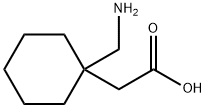
Gabapentin ??
- ???
- 162°C
- ?? ?
- 314.4±15.0 °C(Predicted)
- ??
- 1.058±0.06 g/cm3(Predicted)
- ???
- 9℃
- ?? ??
- 2-8°C
- ???
- H2O: 10 mg/mL
- ??? ??
- ??
- ??? ??
- ??? ??
- ?? ?? (pKa)
- pKa1 (25°) 3.68; pKa2 10.70
- ??
- ???
- ???
- water: 100mM
- Merck
- 14,4319
- BRN
- 2359739
- BCS Class
- 3
- ???
- ??? ?? ?????? 1? ?? ??????. ??? ??? -20°C?? ?? 3?? ?? ??? ? ????.
- ?? ??
- ???(???)
- InChI
- 1S/C9H17NO2/c10-7-9(6-8(11)12)4-2-1-3-5-9/h1-7,10H2,(H,11,12)
- InChIKey
- UGJMXCAKCUNAIE-UHFFFAOYSA-N
- SMILES
- NCC1(CCCCC1)CC(O)=O
- CAS ??????
- 60142-96-3(CAS DataBase Reference)
??
- ?? ? ?? ??
- ?? ? ???? ?? (GHS)
| ??? ?? | T,Xi,F | ||
|---|---|---|---|
| ?? ???? ?? | 61-36/37/38-39/23/24/25-23/24/25-11 | ||
| ????? | 53-26-36/37/39-45-36-36/37-16 | ||
| ????(UN No.) | UN3259 | ||
| WGK ?? | 3 | ||
| RTECS ?? | GU6496000 | ||
| ?? ?? | IRRITANT | ||
| HS ?? | 29224999 | ||
| ???? ??? | 3 - Flammable liquids | ||
| Hazard Classifications | Acute Tox. 3 Dermal Acute Tox. 3 Inhalation Acute Tox. 3 Oral Flam. Liq. 2 STOT SE 1 |
||
| ?? ?? ??? | 60142-96-3(Hazardous Substances Data) |


Gabapentin C??? ??, ??, ??
??
Gabapentin was introduced in 1993 in the UK and early 1994 in the USA as an adjunctive therapy in the treatment of refractory partial seizures and secondarily generalized tonic-clonic seizures. Although being a lipophilic analog of the neurotransmitter GABA, gabapentin appears to exert its anticonvulsive function by a GABA receptor independent mechanism, possibly involving the L-system amino acid transporter protein. Gabapentin easily crosses the blood brain barrier and exhibits a favorable pharmacokinetic profile with high tolerability. It does not interfere with the metabolism of other concomitant administered antiepileptic drugs, thus having a low potential for drug interactions. Studies are currently underway for the use of gabapentin as mono-therapy for the treatment of various seizures.??? ??
White Crystalline Solid??
Gabapentin is a pharmacologically active amino acid, discovered by the pharmaceutical company Parke-Davis, now owned by Warner-Lambert, a division of Pfizer in 1974. Although it was first approved as a treatment for partial seizures in 1993, Pfizer pleaded guilty to illegally marketing gabapentin for unapproved uses in 2004 and was heavily fined by the US Department of Justice for defrauding public health care programs. When this adjunctive use was approved by the US Food and Drug Administration (FDA) in late 1993, Warner-Lambert released gabapentin under the brand name Neurontin, expecting it to make no more than $500,000. But the 2001 sales of Neurontin raked in $1.2 billion.??
Gabapentin is an Amino acid structurally related to γ-Aminobutyric Acid (GABA), designed to cross the blood brain barrier. Used as an anticonvulsant.Indications
Gabapentin (Neurontin) significantly decreases pain scores and sleep interference associated with PHN. An initial dose of 300 mg/day is increased over 4 weeks (900, 1,800, 2,400, 3,600 mg/day divided t.i.d.) until efficacy is obtained or side effects become intolerable.??
ChEBI: Gabapentin is a gamma-amino acid that is cyclohexane substituted at position 1 by aminomethyl and carboxymethyl groups. Used for treatment of neuropathic pain and restless legs syndrome. It has a role as an anticonvulsant, a calcium channel blocker, an environmental contaminant and a xenobiotic. It is functionally related to a gamma-aminobutyric acid.Biological Functions
Gabapentin (Neurotonin) was initially designed to be a rigid analogue of GABA. When it was discovered to have antiepileptic properties, it was assumed that this activity was related to a GABAergic mechanism. However, subsequent studies have failed to show any GABAergic activity of gabapentin. Although it has not yet been possible to ascribe any definite mechanism to its antiepileptic activity, there is recent evidence that it may function as an agonist at GABAB receptors in the brain.Gabapentin is recommended as adjunctive therapy in the treatment of partial seizures in adults.When used with other drugs, it appears to be an effective AED; it is usually not effective when employed alone for patients with severe seizures.
Gabapentin is generally well tolerated, with somnolence, dizziness, and ataxia the most commonly reported adverse effects. A low incidence of potentially serious side effects and no significant allergic reactions have been reported.
?? ??
Gabapentin and its closely related analog pregabalin,(S)-3-isobutyl-GABA, are broad-spectrum anticonvulsantswith multiple mechanisms of action.24,51 Inaddition to modulating calcium influx and stimulateGABA biosynthesis as discussed earlier, they also competefor the biosynthesis of L-glutamic acid because oftheir structural similarity to L-leucine.51 Gabapentin andpregabalin have very little liability for causing metabolicbaseddrug–drug interactions, particularly when used incombination with other AEDs because they are not metabolizedin humans. More than 95% of the drug is excretedunchanged through the kidneys. However, there are somedifferences in their bioavailability. Unlike gabapentin,which exhibits 60% bioavailability when given in lowdoses because of intestinal uptake by a saturable smallneutral L-amino acid transporter, the absorption of pregabalinis almost complete (98%) and exhibits an ideal linear pharmacokinetic profile.24 This high bioavailability of pregabalincan be attributed to its closer structure similarity tothe essential amino acid, L-leucine.???? ??
Anticonvulsant with several possible mechanisms of action. Increases GABA in the brain and binds to a novel site associated with voltage-sensitive Ca 2+ channels. Prevents neuronal death and is antinociceptive and anxiolytic.???
Long-Term Side Effects of Gabapentin:- Mood changes.
- Behavioral changes.
- Depression.
- Anxiety.
- Memory loss.
- Weakened muscles.
???
Dose-limiting adverse effects include somnolence, dizziness, ataxia, peripheral edema, and infection (22).Gabapentin ?? ?? ? ???
???
?? ??
Gabapentin ?? ??
???( 893)?? ??
| ??? | ?? | ??? | ?? | ?? ? | ?? |
|---|---|---|---|---|---|
| Jinan Million Pharmaceutical Co., Ltd | 0531-68659554 +8613031714605 |
info@millionpharm.com | China | 183 | 58 |
| Shaanxi TNJONE Pharmaceutical Co., Ltd | |
sarah@tnjone.com | China | 1139 | 58 |
| Guangzhou Tengyue Chemical Co., Ltd. | +86-86-18148706580 +86-18826483838 |
evan@tyvovo.com | China | 140 | 58 |
| Shaanxi Dideu Medichem Co. Ltd | +86-029-81138252 +86-173 9270 1263 |
1057@dideu.com | China | 3955 | 58 |
| Shaanxi Dideu Medichem Co. Ltd | +86-17392712779 |
1097@dideu.com | China | 3989 | 58 |
| RongNa Biotechnology Co.,Ltd | +86-86-13583358881 +8618560316533 |
Brad@rongnabiotech.com | China | 3371 | 58 |
| Wuhan Nutra Biotechnology Co.,Ltd | |
nutrabiotech@outlook.com | China | 298 | 58 |
| Changzhou Rokechem Technology Co., Ltd. | 18758118018 |
sales001@rokechem.com | China | 254 | 58 |
| Firsky International Trade (Wuhan) Co., Ltd | +8615387054039 |
admin@firsky-cn.com | China | 422 | 58 |
| Anhui Yiao New Material Technology Co., Ltd | +86-18033737140 +86-17354101231 |
sales1@hbganmiao.com | China | 217 | 58 |
Gabapentin ?? ??:
???????? D-????? ???? ???????? ?? ????????? ??? ????????? ??????????? ???? ???????
Glycyl-glycyl-glycine
Cyclohexylacetic acid
Topotecan hydrochloride
Hyaluronic acid
Methoxyammonium chloride
Ascoric Acid
(1-[(9H-FLUOREN-9-YLMETHOXYCARBONYLAMINO)-METHYL]-CYCLOHEXYL)-ACETIC ACID
GABAPENTIN-D6 HYDROCHLORIDE