


???????
|
|
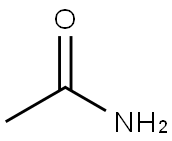
??????? ??
- ???
- 78-80 °C(lit.)
- ?? ?
- 221 °C(lit.)
- ??
- 1.159
- ???
- 1 mm Hg ( 65 °C)
- ???
- 1.4274
- ???
- 220-222°C
- ?? ??
- Store below +30°C.
- ???
- H2O: 0.5 g/mL, Hazen≤50
- ??? ??
- ????
- ?? ?? (pKa)
- 0.63(at 25℃)
- ??
- ???
- ??
- ??? ??
- ???? ??
- synthetic
- ???
- 2000g/L(20℃)
- Merck
- 14,43
- JECFA Number
- 1592
- BRN
- 1071207
- Henry's Law Constant
- 5.3×10³ mol/(m3Pa) at 25℃, Wolfenden (1976)
- ?? ??
- ACGIH TLV-TWA:1 ppm (2.42 mg/m3),Inhalable fraction and vapor
- Dielectric constant
- 41.0(20℃)
- ???
- ????. ??, ????, ???? ???? ????.
- InChI
- 1S/C2H5NO/c1-2(3)4/h1H3,(H2,3,4)
- InChIKey
- DLFVBJFMPXGRIB-UHFFFAOYSA-N
- SMILES
- CC(N)=O
- LogP
- -1.26
- CAS ??????
- 60-35-5(CAS DataBase Reference)
- IARC
- 2B (Vol. 7, Sup 7, 71) 1999
- NIST
- Acetamide(60-35-5)
??
- ?? ? ?? ??
- ?? ? ???? ?? (GHS)
| ??? ?? | Xn | ||
|---|---|---|---|
| ?? ???? ?? | 40 | ||
| ????? | 36/37 | ||
| ????(UN No.) | UN 3077 9/PG 3 | ||
| WGK ?? | 1 | ||
| RTECS ?? | AB4025000 | ||
| F ?????? | 3 | ||
| ?? ?? ?? | 560°C | ||
| TSCA | TSCA listed | ||
| ?? ?? | 9 | ||
| HS ?? | 29241900 | ||
| ???? ??? | 11 - Combustible Solids | ||
| Hazard Classifications | Carc. 2 | ||
| ?? ?? ??? | 60-35-5(Hazardous Substances Data) | ||
| ?? | LD50 orally in Rabbit: 7000 mg/kg | ||
| ???? ?? | KE-00004 |

??????? C??? ??, ??, ??
??
??? ???? ???????? ?? ? ?????. ??? ???? ???? ?? ??? ????, ???? ???? ??? ?? ?? ? ???. ??? ??? ? ?? ??? ??? ??? ?????.??
"1. ?? ??? ???? ??? ?? ? ?? ????? ??? ?????. ?? ???? ??? ???? ?? ? ???? ?? ???? ?? ??? ?? ???? ? ?? ???? ??? ? ????. ?? ???? ???, ??? ??? ???, ?? ??? ??? ? chloramphenicol? ?? ??? ?? ??? ?? ?????. 2. ?? ??, ??, ???, ???? ?????. ?? ?? ??, ?? ??, ?? ???? ??? ? ????. 3. ???, ??? ?? ???? ?????."?? ??
??? ???? ?? ???? ??? ??? ??? ??? ? ?? ?????. ??, ??, ?? ? ? ??? ???? ??? ? ??? ?? ?? ??? ??? ? ????.??
Acetamide (MEA or ethanamide), the amide of acetic acid, is a white crystalline solid in pure form with a mousy odor. Low toxicity. It is produced by dehydrating ammonium acetate. Acetamide is found in red beetroot.Acetamide is used primarily as a solvent, plasticizer, and a wetting and penetrating agent. it was used as an intermediate in the synthesis of methylamine, thioacetamide, hypnotics, insecticides, medicinals and various plastics, a soldering flux ingredient, a wetting agent and penetration accelerator for dyes, and as a plasticizer in leather, cloth and coatings.
ethanolamine is an amide made from acetamide and monoethanolamine. It is a clear liquid. In cosmetics and personal care products, It is used in the formulation of bubble baths, hair conditioners, shampoos, wave sets, moisturizers, and other bath and hair care products.It increases the water content of the top layers of the skin by drawing moisture from the surrounding air. It also enhances the appearance and feel of hair, by increasing hair body, suppleness, or sheen, or by improving the texture of hair that has been damaged physically or by chemical treatment.
??? ??
Acetamide occurs as hexagonal colourless deliquescent crystals with a musty odour. It is incompatible with strong acids, strong oxidising agents, strong bases, and triboluminescent materials. Acetamide is used primarily as a solvent, a plasticiser, and a wetting and penetrating agent. Workplace exposures to acetamide are associated with the plastic and chemical industries.??
- Acetamide is often used as plasticizer and as industrial solvent.
- molten acetamide is an excellent solvent for many organic and inorganic compounds.
- Solubilizer.
- renders sparingly soluble substances more soluble in water by mere addition or by fusion.
- stabilizer.
- manufacture of methylamine, denaturing alcohol.
- In organic syntheses.
- Acetamide is used as a co-monomer in the production of polymeric materials such as polyvinyl acetamide, a polymeric product used as an absorbent.
- It can be used for the transamidation of carbxamides in 1,4-dioxane in the absence of a catalyst.
?? ??
Colorless crystals with a mousy odor (NTP, 1999). Low toxicity.??? ?? ??
Deliquescent. Very soluble in water.?? ???
Acetamide may react with azo and diazo compounds to generate toxic gases. May form flammable gases with strong reducing agents. Reacts as a weak bases (weaker than water). Mixing with dehydrating agents such as P2O5 or SOCl2 generates acetonitrile Burns to give toxic mixed oxides of nitrogen (NOx).????
After oral exposures to acetamide, animals developed liver tumors. However, no informa- tion is available on the carcinogenic effects of acetamide in humans. The US EPA has not classifi ed acetamide for carcinogenicity. The IARC has classifi ed acetamide as a Group 2B, meaning a possible human carcinogen.????
The flash point of Acetamide has not been determined, but Acetamide is probably combustible.Safety Profile
Suspected carcinogen with experimental carcinogenic and neoplastigenic data. Moderately toxic by intraperitoneal and possibly other routes. An experimental teratogen. Other experimental reproductive effects. Mutation data reported. See also AMIDES. When heated to decomposition it emits toxic fumes of NOx,.??? ??
Used as a stabilizer, plasticizer, wetting agent; solvent in plastics, lacquers, explosive; soldering flux ingredient; and chemical manufacturingCarcinogenicity
The IARC has determined that there is sufficient evidence of carcinogenicity for acetamide in experimental animals and that it is possibly carcinogenic to humans.????
The mechanism of toxicity of acetamide is not known; the response profile is quite different from the better studied dimethyl derivative. Acetamide appears to be in a class of chemicals which, although producing liver cancer in rodents, is less sensitive to inactive in genetic tests looking at formation of micronuclei. The carcinogenic response in rodents appears related to the formation of hydroxylamine from the primary metabolite acetohydroxamic acid.??
Acetamide should be kept stored in a tightly closed container, in a cool, dry, ventilated area. It should be protected against physical damage, away from any source of heat, ignition, or oxidizing materials.?? ??
UN3077 Environmentally hazardous substances, solid, n.o.s., Hazard class: 9; Labels: 9-Miscellaneous hazardous material, Technical Name RequiredPurification Methods
Acetamide is crystallised by dissolving in hot MeOH (0.8mL/g), diluting with Et2O and allowing to stand [Wagner J Chem Edu 7 1135 1930]. Alternate crystallisation solvents are acetone, *benzene, chloroform, dioxane, methyl acetate or *benzene/ethyl acetate mixtures (3:1 and 1:1). It has also been recrystallised from hot water after treating with HCl-washed activated charcoal (which had been repeatedly washed with water until free from chloride ions), then crystallised again from hot 50% aqueous EtOH and finally twice from hot 95% EtOH [Christoffers & Kegeles J Am Chem Soc 85 2562 1963]. Finally it is dried in a vacuum desiccator over P2O5. Acetamide is also purified by distillation (b 221-223o) or by sublimation in vacuo. It has also been purified by two recrystallisations from cyclohexane containing 5% (v/v) of *benzene. Needle-like crystals separate and are filtered, washed with a small volume of distilled H2O and dried with a flow of dry N2. [Slebocka-Tilk et al. J Am Chem Soc 109 4620 1987, Beilstein 2 H 175, 2 I 80, 2 II 177, 2 III 384, 2 IV 399.]? ???
Reacts with strong acids, such as hydrochloric, sulfuric, and nitric, strong oxidizers; strong bases; strong reducing agents such as hydrides; ammoniaisocyanates, phenols, cresols. Contact with water causes slow hydrolyzation to ammonia and acetate salts.??? ??
Add to alcohol or benzene as a flammable solvent and incinerate; oxides of nitrogen produced may be scrubbed out with alkaline solution. All federal, state, and local environmental regulations must be observed.?? ??
During handling and/use of acetamide, workers should wear special protective equipment. After leaving work areas, workers should wash hands, face, forearms, and neck, dispose of outer clothing, and change to clean garments at the end of the day.??????? ?? ?? ? ???
???
?? ??
3-AMINO-4-PYRIDINECARBOXYALDEHYDE HYDROCHLORIDE
4-CHLORO-2,6-DIMETHYL-NICOTINIC ACID
Cefaclor monohydrate
3-Aminoisonicotinic acid
3-Amino-2-pyridinecarboxylic acid
BENORILATE
3-AMINO-ISONICOTINIC ACID METHYL ESTER
3-TERT-??????????-??????
3-(9H-FLUOREN-9-YLMETHOXYCARBONYLAMINO)-ISONICOTINIC ACID
2,4-??????
??????????????
ETHYL 4-CHLORO-2,6-DIMETHYLPYRIDINE-3-CARBOXYLATE
3-(2,2-???-????????)-??????
?????
N-ACETYLHOMOPIPERAZINE
Trimethyl thiazole
4-Amino-6-chloropyrimidine
4-(??????)????? ?????
3-AMINO-ISONICOTINIC ACID ETHYL ESTER
?????? ????
3-HYDROXY-4-PYRIDINECARBOXYLIC ACID
4-???-5-?????????????
???????
(3-AMINO-PYRIDIN-4-YL)-METHANOL
?????
3,4-???????????
N,O-??(??????)???????
2-FLUOROQUINOLINE-7-CARBOXYLIC ACID
??????
????
1,2,4,5-??????????
??????????
2-Methylthiazole
4-???????-???-3-OL
4-ETHYL-6-HYDROXY-2-METHYLPYRIMIDINE
??????????
??????
1,2,4,5-?????? ??
3-IODOISONICOTINIC ACID
3-AMINO-PYRIDINE-4-CARBALDEHYDE
??????? ?? ??
???( 650)?? ??
| ??? | ?? | ??? | ?? | ?? ? | ?? |
|---|---|---|---|---|---|
| Hebei Chuanghai Biotechnology Co., Ltd | +86-15350571055 |
Sibel@chuanghaibio.com | China | 8737 | 58 |
| Hebei Chuanghai Biotechnology Co,.LTD | +86-86-13131129325 |
sales1@chuanghaibio.com | China | 5218 | 58 |
| Henan Fengda Chemical Co., Ltd | +86-371-86557731 +86-13613820652 |
info@fdachem.com | China | 20111 | 58 |
| Hebei Zhuanglai Chemical Trading Co.,Ltd | 13343047651 |
admin@zlchemi.com | China | 3689 | 58 |
| Guangzhou Tosun Pharmaceutical Ltd | +86-020-61855200-902 +86-18124244216 |
info@upharm.cn | China | 896 | 58 |
| Capot Chemical Co.,Ltd. | +86-(0)57185586718 +86-13336195806 |
sales@capot.com | China | 29626 | 60 |
| Henan Tianfu Chemical Co.,Ltd. | +86-0371-55170693 +86-19937530512 |
info@tianfuchem.com | China | 21531 | 55 |
| Shanghai Time Chemicals CO., Ltd. | +86-021-57951555 +8618017249410 |
jack.li@time-chemicals.com | China | 1796 | 55 |
| ATK CHEMICAL COMPANY LIMITED | +undefined-21-51877795 |
ivan@atkchemical.com | China | 32998 | 60 |
| career henan chemical co | +86-0371-86658258 |
sales@coreychem.com | China | 29766 | 58 |
??????? ?? ??:
N,N-????????? 2-????????? ??????? 2'-???????????? 2-?????????? ?? ????????? 2,2-????-N-[2-?????-1-(???????)-2-[4-(?????)??]??]?????? p-?????????? ?????? ???????? ? ??? ???? 2,2-????-3-???????????
4'-Chloro-2',5'-dimethoxyacetoacetanilide
Aceglutamide
SirReal2
Tri-O-acetyl-D-glucal
Acetyl bromide
Acetanilide
HEXANAMIDE