


????
|
|
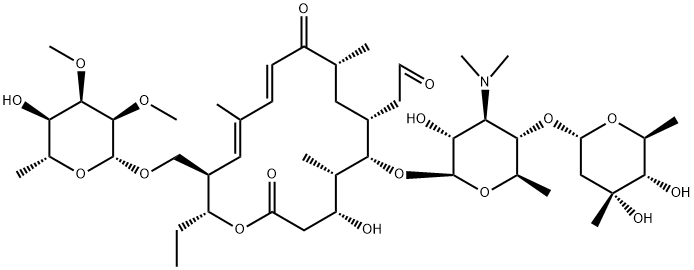
???? ??
- ???
- 135-137°C
- ??
- D25 -46° (c = 2 in methanol)
- ?? ?
- 796.05°C (rough estimate)
- ??
- 1.1424 (rough estimate)
- ???
- 1.5280 (estimate)
- ?? ??
- Sealed in dry,2-8°C
- ???
- DMF: 30 mg/ml; DMSO: 25 mg/ml; Ethanol: 30 mg/ml
- ??? ??
- ??? ??
- ?? ?? (pKa)
- pKa 7.73(H2O t = 25 I = 0.167) (Uncertain)
- ??
- White to light yellow
- ???
- H2O: ??? 50mg/mL
- Henry's Law Constant
- 1.7×1032 mol/(m3Pa) at 25℃, HSDB (2015)
- ???
- Solutions are stable at pH 4-9 (most stable at pH 7);
Below pH 4 tylosin B (desmycosin) is formed as a result of acid hydrolysis;
In neutral and alkaline pH – tylosin aldol (TAD) is formed together with polar degradation products of unknown identity;
When tylosin solution is exposed to daylight, a photodegradation product - isotylosin A (isoTA) is formed.
- ?? ??
- ??
??? ??
- InChIKey
- WBPYTXDJUQJLPQ-VMXQISHHSA-N
??
- ?? ? ?? ??
- ?? ? ???? ?? (GHS)
| ??? ?? | Xn,N | ||
|---|---|---|---|
| ?? ???? ?? | 42/43-50 | ||
| ????? | 36-61-45-36/37-22 | ||
| WGK ?? | WGK 2 | ||
| HS ?? | 2941906000 | ||
| ???? ??? | 11 - Combustible Solids | ||
| Hazard Classifications | Resp. Sens. 1 Skin Sens. 1 |
||
| ?? ?? ??? | 1401-69-0(Hazardous Substances Data) | ||
| ?? | Tylosin base and its salts were shown to be of low acute oral toxicity with LD50 values in excess 5000 mg/kg bw in the rat and mouse and greater than 800 mg/kg bw in the dog. | ||
| ???? ?? | KE-35033 |
| ????(GHS): |

|
|||||||||||||||||||||
|---|---|---|---|---|---|---|---|---|---|---|---|---|---|---|---|---|---|---|---|---|---|---|
| ?? ?: | Danger | |||||||||||||||||||||
| ??·?? ??: |
|
|||||||||||||||||||||
| ??????: |
|

???? C??? ??, ??, ??
??
Tylosin is a macrolide antibiotic produced by S. fradiae that has bacteriostatic activity against Gram-positive bacteria. It is a mixture of tylosin A, B, C, and D, with tylosin A contributing 80% of its bacteriostatic activity. Tylosin has MIC values of 9.6, 16.4, 0.1, 1, and 0.5 μg/ml for F. necrophorum, A. pyogenes, M. gallisepticum, S. aureus, and S. uberis, respectively.,, Formulations containing tylosin have been used for the prevention of liver abscesses in cattle. Tylosin is an environmental contaminant because it is not fully metabolized by treated livestock and enters the environment through manure-based fertilizers.??? ??
Off-White to Pale Yellow Solid.Tylosin is a macrolide antibiotic which is active against certain Gram-positive and Gram-negative bacteria and Gram-positive mycoplasmas. It consists predominantly of tylosin(factor A), but varying amounts of desmycosin (factor B), macrocin (factor C) and relomycin(factor D) may also be present, depending on the manufacturing source. Most of themicrobiological activity resides with tylosin factor A.

Tylosin is a weak organic base with a high degree of lipid solubility, thus it is well distributed to the organs and tissues of animals (Burrows, 1980).
Tylosin is used in pigs, cattle and poultryfor the treatment of conditions caused by sensitive organisms. It may be administered by oral orparenteral routes. Tylosin is not used in human medicine.
??
Tylosin is a 16-membered macrocyclic lactone isolated from Streptomyces fradiae in 1961. Tylosin has broad spectrum antibacterial activity and was developed as a veterinary pharmaceutical for treatment of bacterial infections in a range of domestic animals . Tylosin acts by binding to the 50S ribosomal subunit resulting in the inhibition of protein synthesis in bacteria.??
ChEBI: A macrolide antibiotic that is tylonolide having mono- and diglycosyl moieties attached to two of its hydroxy groups. It is found naturally as a fermentation product of Streptomyces fradiae.Indications
In cattle, tylosin is used for treatment of BRD caused by Mannheimia, Pasteurella multocida, and Histophilus somni (formerly Haemophilus somnus). It is used for interdigital necrobacillosis (foot rot) in cattle caused by Fusobacterium necrophorum or Bacteroides melaninogenicus. In pigs, it is used for treatment of swine arthritis caused by Mycoplasma hyosynoviae, swine pneumonia caused by Pasteurella spp., swine erysipelas caused by Erysipelothrix rhusiopathiae, swine dysentery associated with Serpulina (Treponema) hyodysenteriae, and proliferative enteropathy caused by L. intracellularis. For treatment in pigs, it is also added to feed (Type A–medicated feed article) or drinking water. In small animals, it is used for gram-positive soft tissue and skin infections. However, the most common use in dogs is for treatment of diarrhea, referred to as antibiotic-responsive diarrhea, that has not responded to other treatments. The etiology of the diarrhea is not known but may be caused by Clostridium or Camphylobacter. For this use, the powdered formulation (swine formulation) is most often added to food daily for maintenance.?? ?? ??
Tylosin is a macrolid antibiotic used in veterinary medicine. Occupational exposure concerns farmers, breeders, animal feed workers, and veterinarians.Mechanism of action
Tylosin is a 16-membered macrolide approved for therapy of a variety of infections in pigs, cattle, dogs, and poultry (see indications below). It is formulated as tylosin tartrate or tylosin phosphate. Like other macrolide antibiotics, tylosin inhibits bacteria by binding to the 50S ribosome and inhibiting protein synthesis. Spectrum of activity is limited primarily to gram-positive aerobic bacteria. Clostridium and Campylobacter are usually sensitive. The spectrum also includes the bacteria that cause BRD. Escherichia coli and Salmonella are resistant. In pigs, Lawsonia intracellularis is sensitive.???
Tylosin may cause diarrhea in some animals. However, oral treatment for colitis in dogs has been administered for several months with safety. Skin reactions have been observed in pigs. Oral administration to horses has been fatal.Safety Profile
Poison by intravenous route. Moderately toxic by ingestion and intraperitoneal routes. When heated to decomposition it emits toxic fumes of NOx. See also TnOSIN HYDROCHLORIDE.???? ?? ?? ? ???
???
?? ??
???? ?? ??
???( 329)?? ??
| ??? | ?? | ??? | ?? | ?? ? | ?? |
|---|---|---|---|---|---|
| Hebei Chuanghai Biotechnology Co., Ltd | +86-15350571055 |
Sibel@chuanghaibio.com | China | 8738 | 58 |
| Hebei Chuanghai Biotechnology Co., Ltd | +86-17732866630 |
mina@chuanghaibio.com | China | 18126 | 58 |
| Anhui Ruihan Technology Co., Ltd | +undefined17756083858 |
daisy@anhuiruihan.com | China | 973 | 58 |
| Shaanxi TNJONE Pharmaceutical Co., Ltd | |
sarah@tnjone.com | China | 1143 | 58 |
| Henan Suikang Pharmaceutical Co.,Ltd. | +86-18239973690 |
sales@suikangpharm.com | China | 311 | 58 |
| Shaanxi Xianhe Biotech Co., Ltd | +86-17709210191; +86-17709210191 |
Jerry@xhobio.com | China | 906 | 58 |
| Hefei Lbao Physical & Chemical Science Co.,Ltd | |
lbaochemicals@gmail.com | China | 670 | 58 |
| Capot Chemical Co.,Ltd. | +86-(0)57185586718 +86-13336195806 |
sales@capot.com | China | 29640 | 60 |
| Henan Tianfu Chemical Co.,Ltd. | +86-0371-55170693 +86-19937530512 |
info@tianfuchem.com | China | 21585 | 55 |
| career henan chemical co | +86-0371-86658258 |
sales@coreychem.com | China | 29812 | 58 |
???? ?? ??:
????
TYLOSIN PHOSPHATE FOR PEAK IDENTIFICATION
Tylosin tartrate
Pleuromulin
Tiamulin
TYLOSINA PHOSFATO PREMIX 22%
Telithromycin
Tulathromycin A
Tiamulin fumarate
Tylosin for system suitability
Tylosin phosphate
TYLOSIN D
Tylosin
Tilmicosin
Tylosin tartrate
TYLOSIN TARTRATE - REFERENCE SPECTRUM
Tylosin, 23-di-O-de(6-deoxy-2,3-di-O-methyl-beta-D-allopyranosyl)-, 3- acetate-4B-(3-methylbutanoate)-
Tylosin, 3-acetate 4B-(3-methylbutanoate)