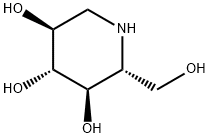
1-Deoxynojirimycin (DNJ), a product of fermentation, exists in mulberry leaves and Commelina communis (dayflower) as well as is isolated from several bacterial strains such as Bacillus and Streptomyces species. Mulberry, a common deciduous plant, belongs to the genus Morus (Moraceae family). Numerous researchers have reported the DJN contents in different parts and various varieties of mulberry. Various mulberry varieties contain DNJ contents ranging between 0.68 and 2.78 mg/gm, while this fraction varies between 1.57 and 3.48 mg/gm in different Chinese mulberry leaves. Moreover, mulberry shoots contain the highest contents of DNJ, followed by young mulberry leaves. Mature leaves of mulberry contain the least content of DNJ. All the mulberry leave groups showed a 1–2-fold increase in DNJ contents compared to unfermented mulberry leaf powder extract (UFMLE). Additionally, fermented mulberry leaf powder extract exhibited higher α-glucosidase activity than UFMLE. DNJ-rich food products can be prepared by fermenting mulberry leaves using the above-mentioned fermenting agents[6].
??
An alpha-glucosidase inhibitor. Interferes with normal processing of N-linked glycoproteins.(+)-1-Deoxynojirimycin acts as an inhibitor of alfa-glucosidase I and II and maltase-glucoamylase. It also inhibits mammalian glucosidase, intestinal and lysosmal, beta-glucosidase from sweet almonds, pancreatic alfa-amylase and amyloglucosidase. Further, it serves as a enzyme enhancer for the treatment of Fabry and Pompe disease.
??
ChEBI: An optically active form of 2-(hydroxymethyl)piperidine-3,4,5-triol having 2R,3R,4R,5S-configuration.
???? ??
Inhibitor of glucosidase I (K i = 2.1 mM) and II (K i = 7 mM).