


???(Ⅳ)
|
|
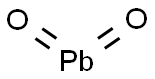
???(Ⅳ) ??
- ???
- 290 °C
- ??
- 9,38 g/cm3
- ??? ??
- ??
- Specific Gravity
- 9.38
- ??
- ???? ?????
- ???
- ???
- ??
- Cp(crystal): 0.27 J/(g·K), at 25℃
- crystal system
- Nogata
- Merck
- 14,5407
- Space group
- Pbcn
- Lattice constant
a/nm b/nm c/nm α/o β/o γ/o V/nm3 0.4948 0.5951 0.5497 90 90 90 0.1619
- ?? ??
- ACGIH: TWA 0.05 mg/m3
NIOSH: IDLH 100 mg/m3; TWA 0.050 mg/m3
- InChI
- InChI=1S/2O.Pb
- InChIKey
- YADSGOSSYOOKMP-UHFFFAOYSA-N
- SMILES
- [Pb](=O)=O
- CAS ??????
- 1309-60-0(CAS DataBase Reference)
??
- ?? ? ?? ??
- ?? ? ???? ?? (GHS)
| ??? ?? | O,T,N | ||
|---|---|---|---|
| ?? ???? ?? | 61-8-20/22-33-50/53-62 | ||
| ????? | 53-45-60-61 | ||
| ????(UN No.) | UN 1872 | ||
| WGK ?? | 3 | ||
| RTECS ?? | OG0700000 | ||
| TSCA | TSCA listed | ||
| ?? ?? | 5.1 | ||
| ???? | III | ||
| HS ?? | 28249090 | ||
| ???? ??? | 5.1B - Oxidizing hazardous materials | ||
| Hazard Classifications | Acute Tox. 4 Inhalation Acute Tox. 4 Oral Aquatic Acute 1 Aquatic Chronic 1 Ox. Sol. 3 Repr. 1A STOT RE 2 |
||
| ?? ?? ??? | 1309-60-0(Hazardous Substances Data) | ||
| ?? | LD50 i.p. in guinea pigs: 220 mg/kg (Venugopal, Luckey) | ||
| ???? ?? | KE-21908 | ||
| ?????? ??? | 97-1-9 | ||
| ?????? ??? | ??1-102 | ||
| ?? ? ???? | ????: ????; ???(??)????: ????(lead tetraoxide), ???(lead sulfate), ??????(basic lead carbonate)? ??? ????(Lead compounds) ? ?? 25% ?? ??? ???. ??, ???(lead acetate), ????(lead alkyls), ?????(lead azide), ????(lead di(acetate)), ??????(lead(Ⅲ) methansulfonate), ???(lead phosphate(3:2)), ?????(lead styphate)? ??? ?? 0.5% ?? ??? ??? |


???(Ⅳ) C??? ??, ??, ??
??
Lead dioxide, PbO2, also plumbic oxide, is an odorless dark-brown crystalline powder which is nearly insoluble in water. It exists in two crystalline forms. The a phase has orthorhombic symmetry, lattice constants a=0.497 nm, b=0.596 nm, c= 0.544 nm, Z=4 (four formula units per unit cell).??? ??
Lead dioxide is a dark brown crystalline solid or powder.??? ??
Red tetragonal crystals or brown powder; density 9.64 g/cm3; decomposes on heating at 290°C; practically insoluble in water; also insoluble in alkalis; moderately soluble in hydrochloric acid and also, in nitric acid-hydrogen peroxide mixture; slowly dissolves in acetic acid.??
Lead dioxide occurs in nature as the mineral plattnerite. It is used as an oxidizing agent in manufacturing dyes and intermediates. It also is used as a source of oxygen in matches, pyrotechnics, and explosives. In matches, the oxide is combined with amorphous phosphorus as an ignition surface. It also is used in making lead pigments, liquid polysulfide polymers and rubber substitutes. Lead dioxide electrodes are used in lead storage batteries in which lead dioxide accumulates on positive plates.??
Lead dioxide occurs in nature as the mineral plattnerite. It is used as an oxidizing agent in manufacturing dyes and intermediates. It also is used as a source of oxygen in matches, pyrotechnics, and explosives. In matches, the oxide is combined with amorphous phosphorus as an ignition surface. It also is used in making lead pigments, liquid polysulfide polymers and rubber substitutes. Lead dioxide electrodes are used in lead storage batteries in which lead dioxide accumulates on positive plates.?? ??
Lead dioxide is produced by oxidizing an alkaline slurry of lead monoxide with chlorine, sodium hypochlorite, or bleaching powder. Alternatively, it is obtained by passing chlorine into a hot aqueous suspension of lead sulfate and magnesium hydroxide. The ionic reaction is:Pb(OH)3ˉ +ClOˉ → PbO2 + Clˉ+ OHˉ + H2O
It also is produced by electrolysis of acidic solutions of lead salts using a lead or platinum electrode. In such electrolytic process, lead dioxide is deposited on the anode of the cell.
Insoluble powdered lead dioxide also may be obtained when lead tetroxide is heated with nitric acid:
Pb3 O4 + 4HNO3 → 2Pb(N)3)2 + PbO2 + 2H2O
Lead dioxide also can be prepared by fusing lead monoxide with a mixture of sodium nitrate and sodium chlorate.
?? ??
Brown, hexagonal crystals. Insoluble in water. Used in matches, explosives, electrodes.?? ???
Noncombustible but accelerates the burning of combustible material. Reacts violently with hydrogen sulfide [Bretherick 1979. p. 977-978]. Ignites with hydroxylamine [Mellor 8:291. 1946-47]. Reacts violently with hydrogen peroxide [Mellor 1:937 1946-47], with phenylhydrazine [Mellor 7:637 1946-47], or with sulfuryl chloride [Mellor 10:676. 1946-47]. Reacts with incandescence with sulfur dioxide [Mellor, 1941, Vol. 7, 689]. Explodes when ground with boron or yellow phosphorus [Mellor, 1946, Vol. 5, 17]. Mixtures with sulfur and red phosphorus ignite [Mellor, 1941, Vol. 7, 689]. Reacts vigorously when heated with calcium sulfide, strontium sulfide or barium sulfide [Mellor, 1941, Vol. 3, 745].????
Toxic by ingestion. Inhalation of dust is toxic. Fire may produce irritating, corrosive and/or toxic gases. Contact with substance may cause severe burns to skin and eyes. Runoff from fire control or dilution water may cause pollution.????
These substances will accelerate burning when involved in a fire. May explode from heat or contamination. Some may burn rapidly. Some will react explosively with hydrocarbons (fuels). May ignite combustibles (wood, paper, oil, clothing, etc.). Containers may explode when heated. Runoff may create fire or explosion hazard.??? ??
This material is used in electrodes for lead-acid batteries; in matches; explosives, and as a curing agent for polysulfide elastomers?? ??
UN1872 Lead dioxide, Hazard Class: 5.1; Labels: 5.1-Oxidizer.? ???
Lead dioxide is a powerful oxidizer. Violent reaction with many compounds, including reducing agents; chemically active metals; combustible materials, strong acids, alkaline earth sulfides, aluminum carbides, aluminum, amines, calcium sulfide, carbides, chlorine trifluoride, glycerin, hydrides, hydrochloric acid, hydrogen peroxide, hydrogen sulfide, hydroxylamine, magnesium, metal powders, metal sulfides, molybdenum, phenylhydrazine, phosphorous red/friction, phosphorous trichloride, silicon, sulfides, sulfur, sulfur dioxide, sulfur/friction, sulfuric acid, tungsten, hydrogen trisulfide??? ??
Conversion to soluble salt, precipitation as sulfide and return to supplier. Do not discharge into drains or sewers. Dispose of waste material as hazardous waste using a licensed disposal contractor to an approved landfill. Consult with environmental regulatory agencies for guidance on acceptable disposal practices. Containers must be disposed of properly by following package label directions or by contacting your local or federal environmental control agency, or by contacting your regional EPA office.???(Ⅳ) ?? ?? ? ???
???
?? ??
???(Ⅳ) ?? ??
???( 242)?? ??
| ??? | ?? | ??? | ?? | ?? ? | ?? |
|---|---|---|---|---|---|
| Shenyang Simchoice Chemical Co.,Ltd | +86-024-23769576 +86-15040101888 |
sales@simchoicechem.com | China | 252 | 58 |
| Henan Tianfu Chemical Co.,Ltd. | +86-0371-55170693 +86-19937530512 |
info@tianfuchem.com | China | 21531 | 55 |
| career henan chemical co | +86-0371-86658258 |
sales@coreychem.com | China | 29766 | 58 |
| Hefei TNJ Chemical Industry Co.,Ltd. | +86-0551-65418671 +86-189 4982 3763 |
sales@tnjchem.com | China | 34526 | 58 |
| ANHUI WITOP BIOTECH CO., LTD | +8618071025641 |
eric@witopchemical.com | China | 23506 | 58 |
| Dideu Industries Group Limited | +86-29-89586680 +86-15129568250 |
1059@dideu.com | China | 29096 | 58 |
| sgtlifesciences pvt ltd | +91-8790379245 |
dj@sgtlifesciences.com | China | 12351 | 58 |
| Shaanxi Didu New Materials Co. Ltd | +86-86-17392712779 +86-13289823923 |
1090@dideu.com | China | 8651 | 58 |
| GLR Innovations | -- |
info@glrgroup.in | India | 4525 | 58 |
| HANGZHOU LEAP CHEM CO., LTD. | +86-571-87711850 +8619957148339 |
market18@leapchem.com | China | 24569 | 58 |