


Dimethyl dicarbonate
|
|
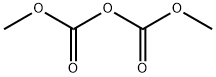
Dimethyl dicarbonate ??
- ???
- 15-17°C
- ?? ?
- 45-46 °C5 mm Hg(lit.)
- ??
- 1.25 g/mL at 25 °C(lit.)
- ???
- 0.7 hPa (20 °C)
- ???
- n
20/D 1.392(lit.)
- ???
- 80 °C
- ?? ??
- Store below +30°C.
- ???
- 35g/l(??)
- ??? ??
- ??
- ??
- ??
- ????
- 3-29.9%(V)
- ???
- 35g/L (decomposition)
- BRN
- 956715
- Henry's Law Constant
- 2.2×10⁻² mol/(m3Pa) at 25℃, HSDB (2015)
- ???
- ??? ???
- InChI
- 1S/C4H6O5/c1-7-3(5)9-4(6)8-2/h1-2H3
- InChIKey
- GZDFHIJNHHMENY-UHFFFAOYSA-N
- SMILES
- O(C)C(=O)OC(=O)OC
- LogP
- 0.082 (est)
??
- ?? ? ?? ??
- ?? ? ???? ?? (GHS)
| ??? ?? | T | ||
|---|---|---|---|
| ?? ???? ?? | 21/22-23-34 | ||
| ????? | 18-26-28-36/37/39-38-45 | ||
| ????(UN No.) | UN 2927 6.1/PG 2 | ||
| WGK ?? | 3 | ||
| RTECS ?? | HT0362500 | ||
| F ?????? | 9-21 | ||
| ?? ?? ?? | 465 °C | ||
| TSCA | TSCA listed | ||
| HS ?? | 2920 90 10 | ||
| ?? ?? | 6.1(a) | ||
| ???? | II | ||
| ???? ??? | 6.1A - Combustible, acute toxic Cat. 1 and 2 very toxic hazardous materials |
||
| Hazard Classifications | Acute Tox. 2 Inhalation Acute Tox. 4 Oral Eye Dam. 1 Skin Corr. 1B |
||
| ?? ?? ??? | 4525-33-1(Hazardous Substances Data) | ||
| ?? | LD50 orally in Rabbit: 335 mg/kg LD50 dermal Rat > 1250 mg/kg | ||
| ???? ?? | KE-10020 |
| ????(GHS): |
 
|
||||||||||||||||||||||||||||
|---|---|---|---|---|---|---|---|---|---|---|---|---|---|---|---|---|---|---|---|---|---|---|---|---|---|---|---|---|---|
| ?? ?: | Danger | ||||||||||||||||||||||||||||
| ??·?? ??: |
|
||||||||||||||||||||||||||||
| ??????: |
|

Dimethyl dicarbonate C??? ??, ??, ??
??? ??
Dimethyl dicarbonate (DMDC) is a colourless liquid with a slightly pungent aroma. It is primarily used as a beverage preservative, processing aid, or sterilant (Enumber 242). The application of DMDC is particularly useful when wine needs to be sterilized but cannot be sterile filtered, pasteurized, or sulfured. DMDC is also used to stabilize non-alcoholic beverages such as carbonated or non-carbonated juice beverages, isotonic sports beverages, iced teas, and flavored waters.??
Dimethyl Dicarbonate(DMDC) is a microbial control agent used in wine; ready-to-drink teas; nonjuice-containing beverages; carbonated,dilute beverages containing juice, fruit flavor or both with the juice content not exceeding 50%.Dimethyl Dicarbonate has been commonly used as a antimicrobial agent for a broad spectrum of microorganisms. The primary target microorganisms of DMDC are yeasts, including Saccharomyces, Zygosaccharomyces, Rhodotorula, Candida, Pichia, Torulopsis, Torula, Endomyces, Kloeckera and Hansenula. DMDC is also bactericidal to a number of species including Acetobacter pasteurianus, Escherichia coli, Pseudomonas aeruginosa, Staphylococcus aureus, several Lactobacillus species and Pediococcus cerevisiae DMDC has also been shown to be bactericidal against Escherichia coli O157:H7.
The antimicrobial effect of DMDC results from the deactivation of microbial enzymes, mainly through reaction with protein imidazole and amine groups, leading to the destruction of the microorganisms. The remaining unreacted DMDC breaks down rapidly into methanol and carbon dioxide. The DMDC activity is based on the hydrolysis rate. Hydrolysis occurs when DMDC reacts with water and the rate is dependent on the temperature of the beverage or wine. It takes about four hours at 10°C (50°F) or two hours at 20°C (68°F) for DMDC completely breaking down.
Biochem/physiol Actions
Dimethyl dicarbonate (DMDC; Velcorin) is a colourless liquid with an ester-like pungent odour. DMDC is soluble in water (3.65% solubility), aqueous solutions (e.g. beverages) and alcohol, where it is quickly hydrolysed. This hydrolysis is a quick process: 1 hour at 30°C and within 5 hours at 10°C. DMDC solidifies below 17 °C. It acts as a microbial control agent by inhibiting the enzymes acetate kinase and L-glutamic acid decarboxylase. DMDC undergoes hydrolyses in the presence of water to form primarily methanol and carbon dioxide, which are natural components of fruit and alcoholic drinks.Purification Methods
Dissolve it in Et2O, shake this with a small volume of 0.1N HCl, dry Et2O with Na2SO4 and distil in in vacuo below 100o to give a clear liquid. It decomposes to CO2 and dimethyl carbonate on heating at 123-149o. It is readily hydrolysed by H2O and is a yeast inhibitor and an IRRITANT. [Brysov et al. J Org Chem USSR 10 2551 1974, Boehm & Mehta Chem Ber 71 1797 1938, Beilstein 3 IV 17.]Dimethyl dicarbonate ?? ?? ? ???
???
?? ??
Dimethyl dicarbonate ?? ??
???( 235)?? ??
| ??? | ?? | ??? | ?? | ?? ? | ?? |
|---|---|---|---|---|---|
| Hefei TNJ Chemical Industry Co.,Ltd. | +86-0551-65418671 +86-189 4982 3763 |
sales@tnjchem.com | China | 34526 | 58 |
| CONIER CHEM AND PHARMA LIMITED | |
sales@conier.com | China | 49906 | 58 |
| Hebei Chuanghai Biotechnology Co., Ltd | +86-15350571055 |
Sibel@chuanghaibio.com | China | 8737 | 58 |
| Hebei Yanxi Chemical Co., Ltd. | +86-17531190177 |
faithe@yan-xi.com | China | 5838 | 58 |
| Hebei Chuanghai Biotechnology Co,.LTD | +86-86-13131129325 |
sales1@chuanghaibio.com | China | 5218 | 58 |
| Hebei Chuanghai Biotechnology Co., Ltd | +86-17732866630 |
mina@chuanghaibio.com | China | 18114 | 58 |
| airuikechemical co., ltd. | +86-18353166132 |
sales02@airuikechemical.com | China | 983 | 58 |
| Hebei Zhuanglai Chemical Trading Co.,Ltd | 13343047651 |
admin@zlchemi.com | China | 3689 | 58 |
| Henan Tianfu Chemical Co.,Ltd. | +86-0371-55170693 +86-19937530512 |
info@tianfuchem.com | China | 21531 | 55 |
| Hefei TNJ Chemical Industry Co.,Ltd. | +86-0551-65418679 +86-18949832763 |
info@tnjchem.com | China | 2984 | 55 |
Dimethyl dicarbonate ?? ??:
??? ????? ??? ????? ? -Tert- ?? ? ?????
Dimethyl sulfoxide
Dibromofluoromethane
Diethyl cyanomethylphosphonate
Dimethyl sulfate
Dimethyl azelate
Dimethyl sebacate
calcium dimethyl dicarbonate
magnesium dimethyl dicarbonate
Dimethyl dicarbonate
DIALLYL DICARBONATE
DI-TERT-AMYL DICARBONATE
Dibenzyl dicarbonate
DIETHYL PYROCARBONATE, [CARBONYL-14C]