|
|
| | 3-PHENYL-1-PROPYNE Basic information |
| Product Name: | 3-PHENYL-1-PROPYNE | | Synonyms: | 3-PHENYL-1-PROPYNE;3-PHENYL-1-PROPYNE 97%;3-Phenyl-1-propyne, stabilized, 97%;(2-Propynyl)benzene;3-Phenyl-1-propyne,97%,stabilized;prop-2-ynylbenzene;3-Phenyl-1-propyne contains 250 ppM BHT as inhibitor, 97%;3-Phenyl-1-propyne contains ca.250 ppm BHT as inhibitor, 97% | | CAS: | 10147-11-2 | | MF: | C9H8 | | MW: | 116.16 | | EINECS: | | | Product Categories: | Alkynes;Organic Building Blocks;Terminal | | Mol File: | 10147-11-2.mol | 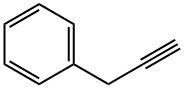 |
| | 3-PHENYL-1-PROPYNE Chemical Properties |
| Boiling point | 75 °C20 mm Hg(lit.) | | density | 0.934 g/mL at 25 °C(lit.) | | refractive index | n20/D 1.526(lit.) | | Fp | 126 °F | | storage temp. | Flammables area | | solubility | Chloroform (Sparingly), DMSO (Slightly) | | form | Liquid | | color | Clear colorless to yellow | | Specific Gravity | 0.934 | | Stability: | Volatile | | InChI | 1S/C9H8/c1-2-6-9-7-4-3-5-8-9/h1,3-5,7-8H,6H2 | | InChIKey | NGKSKVYWPINGLI-UHFFFAOYSA-N | | SMILES | C#CCc1ccccc1 | | CAS DataBase Reference | 10147-11-2 |
| Hazard Codes | Xi | | Risk Statements | 10-36/37/38 | | Safety Statements | 16-26-36/37/39-37/39 | | RIDADR | UN 3295 3/PG 3 | | WGK Germany | 3 | | HazardClass | 3.2 | | PackingGroup | III | | HS Code | 29029090 | | Storage Class | 3 - Flammable liquids | | Hazard Classifications | Eye Irrit. 2
Flam. Liq. 3
Skin Irrit. 2
STOT SE 3 |
| | 3-PHENYL-1-PROPYNE Usage And Synthesis |
| Chemical Properties | Clear colorless to yellow liquid | | Uses | 3-Phenyl-1-propyne is used as a starting material in the synthesis of 4-phenyl-2-butyn-1-ol. It is also used in the preparation of beta-hydroxytriazoles and indoles. | | Synthesis Reference(s) | The Journal of Organic Chemistry, 47, p. 1837, 1982 DOI: 10.1021/jo00349a007 | | General Description | 3-Phenyl-1-propyne is a 3-aryl-1-propyne. The electronic transition of the resonance-stabilized 1-phenylpropargyl radical, produced in a jet-cooled discharge of 3-phenyl-1-propyne, has been studied by laser-induced fluorescence excitation and dispersed single vibronic level fluorescence (SVLF) spectroscopy. The microwave rotational spectrum of 3-phenyl-1-propyne (propargyl benzene) has been studied and its stable conformation is reported to have coplanar carbon atoms. Reaction of N-methyl-N-phenylhydrazine or N-phenylhydrazine with 3-phenyl-1-propyne is reported to yield indoles. 3-Phenyl-1-propyne is reported to react with styrene oxide and sodium azide, to afford β-hydroxytriazoles. |
| | 3-PHENYL-1-PROPYNE Preparation Products And Raw materials |
|