| Company Name: |
Shanghai Huzhen Industrial Co., LTD
|
| Tel: |
021-60345367 13916550749 |
| Email: |
sales@shzbio.com |
| Products Intro: |
Product Name:PAI1
Purity:> 99% Package:50ul/RMB 1098;100ul/RMB 1880;200ul/RMB 2900 Remarks:Clade E; Endothelial plasminogen activator inhibitor; Nexin; PAI 1; PAI; PAI-1; PAI1_HUMAN; PLANH1; Plasminogen activator inhibitor 1; Plasminogen activator inhibitor type 1; Serin
|
| Company Name: |
Bio Rad Laboratories Inc
|
| Tel: |
65-64153170 |
| Email: |
Sales.China@bio-rad.com |
| Products Intro: |
Product Name:PAI-1
|
| Company Name: |
BioVendor R D
|
| Tel: |
420-549124185 |
| Email: |
info@biovendor.com |
| Products Intro: |
Product Name:PAI-1
|
| Company Name: |
Enzo Biochem Inc
|
| Tel: |
Enzo Biochem Inc. 13797054060 |
| Email: |
Enzoname@qq.com |
| Products Intro: |
Product Name:Plasminogen Activator Inhibitor 1
|
|
| Product Name: | PAI-1 | | Synonyms: | ARMAPE;MOUSE PAI-1;MOUSE PLASMINOGEN ACTIVATOR INHIBITOR-1;PAI-1;PAI-1, HUMAN;PAI-1, MOUSE;PAI-1, MUTANT, MOUSE;PAI-1, RAT | | CAS: | 31514-41-7 | | MF: | C27H47N9O9S | | MW: | 673.78 | | EINECS: | | | Product Categories: | enzyme | | Mol File: | Mol File | 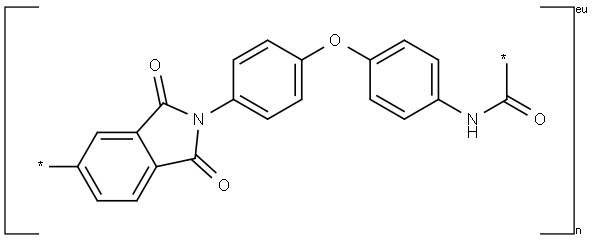 |
| | PAI-1 Chemical Properties |
| storage temp. | -70°C | | form | liquid |
| | PAI-1 Usage And Synthesis |
| Biological Activity | Cell permeable: no', 'Primary Target
Tissue plasminogen activator (tPA) and urokinase (uPA)', 'Product does not compete with ATP.', 'Reversible: no | | Enzyme inhibitor | This 402-residue serine protease inhibitor, or serpin (MW = 45074 g/mol; Abbreviation: PAI-1) binds to and inhibits plasminogen activators-tissuetype plasminogen activator (tPA) and urokinase-type plasminogen activator (uPA). This inhibition reduces plasmin production and suppresses dissolution of fibrin clots. Elevated PAI-1 levels correlate with an increased cardiovascular disease risk, a behavior that has also been linked to obesity and metabolic syndrome. Pharmacological suppression of PAI-1 is a likely way to prevent or treat vascular disease. Reduced PAI-1 levels may result in increased fibrinolysis and an associated bleeding diathesis. PAI-1 was initially identified in the 1980s, and the first reported case of PAI-1 deficiency appeared in 1989. Unambiguous proof that PAI-1 deficiency as a cause of a bleeding disorder has been rare, but use of selective PAI inhibitors (See PAI-749) may clarify this point. Because of lack of standardized commercially available PAI-1 activity assay sensitive in the lowest range, the true prevalence of this rare condition has yet to be established. |
| | PAI-1 Preparation Products And Raw materials |
|