|
|
| | Butyl acrylate-methyl methacrylate polymers Basic information |
| Product Name: | Butyl acrylate-methyl methacrylate polymers | | Synonyms: | Dakril 4B;Kunststoffe, z.B. Granulate, Formteile, Fasern, Folien, Kunststoffharze, soweit sie fest, nicht dispergiert, wasser-unlslich und indifferent sind;Butyl acrylate, methyl methacrylate copolymer;Butyl acrylate-methyl methacrylate copolymers;methyl methacrylate/ butyl acrylate copolymer;Butyl acrylate-methyl methacrylate polymers;MIL-P-85891A,T-5 Acrylic;OBT5 | | CAS: | 25852-37-3 | | MF: | C36H60O12X2 | | MW: | 228.29 | | EINECS: | | | Product Categories: | Polymers | | Mol File: | 25852-37-3.mol | 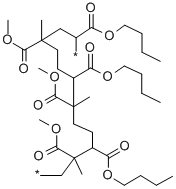 |
| | Butyl acrylate-methyl methacrylate polymers Chemical Properties |
| TSCA | TSCA listed | | Toxicity | LD50 oral in mouse: > 29500mg/kg |
| | Butyl acrylate-methyl methacrylate polymers Usage And Synthesis |
| Description | Bis-PMMA/Polybutyl Acrylate Copolymer is a nitroxide-endcapped triblock copolymer of Butyl Acrylate and Methyl Methacrylate. It is prepared by nitroxide-mediated controlled radical polymerization, wherein a difunctional initiator is used to first prepare | | Definition | Copolymers of n-butyl acrylate/methyl methacrylate (BA/MMA) with certain compositions were proposed as self-healing materials due to “key-and-lock” interchain interactions of alternating sequences[1].
| | References | [1] Stanislaw Sosnowski. “Distribution of Alternating Sequences in Methyl Methacrylate/n-Butyl Acrylate Copolymers Prepared by Atom Transfer Radical Polymerization.” Macromolecules 54 21 (2021): 9837–9849.
|
| | Butyl acrylate-methyl methacrylate polymers Preparation Products And Raw materials |
|