- 10058-F4
-

- $43.00
-
2026-07-20
- CAS:403811-55-2
- Purity: 99.87%
- Supply Ability: 10g
|
| | (Z,E)-5-(4-ETHYLBENZYLIDINE)-2-THIOXOTHIAZOLIDIN-4-ONE Basic information | | Background |
| Product Name: | (Z,E)-5-(4-ETHYLBENZYLIDINE)-2-THIOXOTHIAZOLIDIN-4-ONE | | Synonyms: | (5E)-5-[(4-ethylphenyl)methylidene]-2-sulfanylidene-1,3-thiazolidin-4-one;c-Myc Inhibitor;ZINC01085340;(Z,E)-5-(4-ETHYLBENZYLIDINE)-2-THIOXOTHIAZOLIDIN-4-ONE;5-[(4-Ethylphenyl)methylene]-2-thioxo-4-thiazolidinone;(5E)-5-(4-ethylbenzylidene)-2-mercapto-1,3-thiazol-4(5H)-one;Albb-009118;(5E)-5-(4-ethylbenzylidene)-2-mercapto-1,3-thiazol-4(5H)-one(SALTDATA: FREE) | | CAS: | 403811-55-2 | | MF: | C12H11NOS2 | | MW: | 249.35 | | EINECS: | | | Product Categories: | Inhibitors | | Mol File: | 403811-55-2.mol | 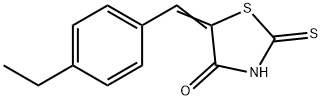 |
| | (Z,E)-5-(4-ETHYLBENZYLIDINE)-2-THIOXOTHIAZOLIDIN-4-ONE Chemical Properties |
| density | 1.33±0.1 g/cm3(Predicted) | | storage temp. | 2-8°C | | solubility | DMSO: >10mg/mL | | form | Yellow solid | | pka | 7.72±0.30(Predicted) | | color | yellow | | Water Solubility | Soluble in DMSO. Soluble in water at concentrations less than 2mg/ml | | Stability: | Stable for 1 year from date of purchase as supplied. Solutions in DMSO or ethanol may be stored at -20° for up to 1 month. | | InChI | 1S/C12H11NOS2/c1-2-8-3-5-9(6-4-8)7-10-11(14)13-12(15)16-10/h3-7H,2H2,1H3,(H,13,14,15)/b10-7+ | | InChIKey | SVXDHPADAXBMFB-JXMROGBWSA-N | | SMILES | CCc1ccc(cc1)\C=C2\SC(=S)NC2=O |
| Hazard Codes | Xi | | Risk Statements | 36-43 | | Safety Statements | 26-36/37 | | WGK Germany | 3 | | HazardClass | IRRITANT | | HS Code | 2934100090 | | Storage Class | 11 - Combustible Solids | | Hazard Classifications | Eye Irrit. 2
Skin Sens. 1 |
| | (Z,E)-5-(4-ETHYLBENZYLIDINE)-2-THIOXOTHIAZOLIDIN-4-ONE Usage And Synthesis |
| Description | 10058-F4 (403811-55-2) effectively disables c-Myc by inhibiting the c-Myc-Max association and function.It prevents the growth of fibroblasts in a c-Myc-dependent manner. Downregulates human telomerase reverse transcriptase and enhances chemosensitivity in human hepatocellular carcinoma cells.10058-F4 induces cell cycle arrest, apoptosis and myeloid differentiation in human acute myeloid leukemia.Inhibits the MYCN/Max interaction leading to cell cycle arrest, apoptosis and neuronal differentiation in MYCN-amplified neuroblastoma cells. | | Uses | A c-Myc inhibitor that induces apoptosis | | Definition | ChEBI: 10058-F4 is a member of the class of thiazolidinones that is 2-sulfanylidene-1,3-thiazolidin-4-one which is substituted at position 5 by a (4-ethylphenyl)methylidene group. It is a cell permeable inhibitor of c-Myc-Max dimerization and exhibits antitumour effects in vivo. It downregulates c-Myc expression and upregulates CDK inhibitors, p21 and p27 resulting in the inhibition of proliferation, induction of apoptosis and cell cycle arrest in G0/G1 phase. It has a role as an apoptosis inducer and an antineoplastic agent. It is a thiazolidinone and an olefinic compound. | | Biochem/physiol Actions | 10058-F4 is a c-Myc inhibitor that induces cell-cycle arrest and apoptosis. 10058-F4 is a cell-permeable thiazolidinone that specificallly inhibits the c-Myc-Max interaction and prevents transactivation of c-Myc target gene expression. 10058-F4 inhibits tumor cell growth in a c-Myc-dependent manner both in vitro and in vivo (64 μM using c-Myc transfected Rat1a fibroblasts). | | storage | Store at +4°C | | Background | The small-molecule 10058-F4 inhibits c-Myc, a transcriptional regulator involved in cell proliferation, differentiation, and apoptosis. Dysregulation of the oncoprotein c-Myc is common in human cancers. 10058-F4 inhibits transactivation of gene expression by c-Myc-Max heterodimers by disrupting the association between c-Myc and the transcription factor Max. 10058-F4 treatment of acute myeloid leukemia cells inhibited c-Myc expression and induced apoptosis and cell arrest at G0/G1. In a mouse neuroblastoma model, 10058-F4 inhibited transactivation by N-Myc-Max, resulting in cell cycle arrest, apoptosis, and tumor growth reduction. Ovarian cancer cells treated with 10058-F4 displayed reduced cell proliferation and enhanced effects of chemotherapeutic drugs. The 10058-F4 inhibitor likely upregulates FOXO transcription factors and downstream genes involved in ovarian G1 cell cycle arrest, apoptosis, and autophagic cell death. 10058-F4 promoted increased expression of thioredoxin-interacting protein in triple-negative breast cancer drug-resistant cells, which promoted reactive oxygen species synthesis and reversed doxorubicin-induced chemotherapy resistance. | | References | [1] XIAOYING YIN. Low molecular weight inhibitors of Myc–Max interaction and function[J]. Oncogene, 2003, 22 40: 6151-6159. DOI:10.1038/sj.onc.1206641
[2] CHE-PIN LIN. Small-molecule c-Myc inhibitor, 10058-F4, inhibits proliferation, downregulates human telomerase reverse transcriptase and enhances chemosensitivity in human hepatocellular carcinoma cells.[J]. Anti-Cancer Drugs, 2007, 18 2: 161-170. DOI:10.1097/cad.0b013e3280109424
[3] MING-JER HUANG . A small-molecule c-Myc inhibitor, 10058-F4, induces cell-cycle arrest, apoptosis, and myeloid differentiation of human acute myeloid leukemia[J]. Experimental hematology, 2006, 34 11: Pages 1480-1489. DOI:10.1016/j.exphem.2006.06.019
[4] HANNA ZIRATH. MYC inhibition induces metabolic changes leading to accumulation of lipid droplets in tumor cells.[J]. Proceedings of the National Academy of Sciences of the United States of America, 2013: 10258-10263. DOI:10.1073/pnas.1222404110 |
| | (Z,E)-5-(4-ETHYLBENZYLIDINE)-2-THIOXOTHIAZOLIDIN-4-ONE Preparation Products And Raw materials |
|