|
|
| | Ethyl 4,6-dichloronicotinate Basic information | | Uses |
| Product Name: | Ethyl 4,6-dichloronicotinate | | Synonyms: | 4,6-Dichloronicotinic acid ethyl ester ,97%;ethyl 4,6-dichloronicotinate (en);Ethyl 4,6-dichloronicotinate ,97%;3-Pyridinecarboxylicacid,4,6-dichloro-,ethylester;4,6-DICHLOROPYRIDINE-3-CARBOXYLIC ACID ETHYL ESTER;4,6-DICHLORONICOTINIC ACID ETHYL ESTER;ETHYL 4,6-DICHLORONICOTINATE;2,4-Dichloro-5-carbethoxypyridine | | CAS: | 40296-46-6 | | MF: | C8H7Cl2NO2 | | MW: | 220.05 | | EINECS: | | | Product Categories: | Pyridine series;Boronic Acid | | Mol File: | 40296-46-6.mol | 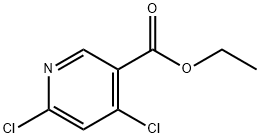 |
| | Ethyl 4,6-dichloronicotinate Chemical Properties |
| Melting point | 32-34° | | Boiling point | 85°C/0.01mmHg(lit.) | | density | 1.367±0.06 g/cm3(Predicted) | | storage temp. | Keep in dark place,Sealed in dry,Room Temperature | | solubility | Soluble in methanol. | | pka | -1.24±0.10(Predicted) | | form | Liquid | | color | Yellow | | InChI | InChI=1S/C8H7Cl2NO2/c1-2-13-8(12)5-4-11-7(10)3-6(5)9/h3-4H,2H2,1H3 | | InChIKey | AAUBVINEXCCXOK-UHFFFAOYSA-N | | SMILES | C1=NC(Cl)=CC(Cl)=C1C(OCC)=O |
| Risk Statements | 36/37/38 | | Safety Statements | 26-36 | | HazardClass | IRRITANT | | HS Code | 29339900 |
| | Ethyl 4,6-dichloronicotinate Usage And Synthesis |
| Uses | Ethyl 4,6-Dichloronicotinate acts as a reactant in the preparation of (acylamino)aminonaphthyridinones as novobiocin analogs and Hsp90 inhibitors, their antitumor activities in human breast cancer cell lines, and the effects on aptoptosis and cell cycle advancement of selected compounds. | | Chemical Properties | White solid | | Uses |
Ethyl 4,6-dichloronicotinate is an important raw material and intermediate used in organic Synthesis, pharmaceuticals, agrochemicals, and dyestuffs. It is also used as a fine chemical intermediate. Ethyl-4,6-dichloronicotinate could be used as a starting material to synthesize 6-chlorothieno[3,2-c]pyridine-2-carbohydrazide-hydrazone subsidiaries[1].
| | Synthesis | The general procedure for the synthesis of ethyl 4,6-dichloronicotinate from ethyl 4,6-dihydroxynicotinate was as follows: ethyl 4,6-dihydroxynicotinate (60 g, 0.328 mol) was slowly added to phosphorus triclosan (POCl3, 500 mL), followed by heating and refluxing for 2 hours. Upon completion of the reaction, the excess phosphorous trichloride was removed by distillation under reduced pressure. The residue was carefully poured into ice water, stirred for 30 min, and then extracted with ethyl acetate (EtOAc, 3 times). The organic phases were combined, washed with saturated brine, dried over anhydrous magnesium sulfate (MgSO4) and finally concentrated under vacuum to give ethyl 4,6-dichloronicotinate (65 g, 90% yield). The product was identified by 1H NMR (300 MHz, DMSO-d6): δ 8.80 (s, 1H), 7.95 (s, 1H), 4.34 (q, J=6.9 Hz, 2H), 1.31 (t, J=6.9 Hz, 3H); Mass Spectra (ESI) m/z: 220.1 [M+H]+. | | References | [1] N. Rao, K. Prasad, M. Rao. “Synthesis and Antibacterial Evaluation of Hydrazone Derivatives Bearing 6-Chlorothieno[3,2-c]pyridine Moiety.” Asian Journal of Chemistry 1 1 (2019). |
| | Ethyl 4,6-dichloronicotinate Preparation Products And Raw materials |
|