|
|
| | 2,5-Dimethoxybenzaldehyde Basic information |
| Product Name: | 2,5-Dimethoxybenzaldehyde | | Synonyms: | 2,5-Dimethoxybenzald;NSC 6315;2,5-Dimethoxybenzaldehyde Vetec(TM) reagent grade, 98%;2,5-DIMETHOXYBENZALDEHYDE;AKOS BBS-00003162;2,5-Dimethoxybenzaldehyde, 98+%;2,5 -Dimethoxybenzaldehyde 2;gentisic aldehyde dimethyl ether | | CAS: | 93-02-7 | | MF: | C9H10O3 | | MW: | 166.17 | | EINECS: | 202-211-5 | | Product Categories: | C9;Carbonyl Compounds;Aromatics;Carbonyl Compounds;Chemical Synthesis;Organic Building Blocks;FINE Chemical & INTERMEDIATES;BUILDING BLOCKS;Benzaldehyde;Adehydes, Acetals & Ketones;Anisoles, Alkyloxy Compounds & Phenylacetates;Aldehydes;93-02-7 | | Mol File: | 93-02-7.mol | 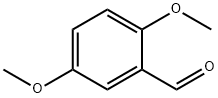 |
| | 2,5-Dimethoxybenzaldehyde Chemical Properties |
| Melting point | 46-48 °C (lit.) | | Boiling point | 146 °C/10 mmHg (lit.) | | density | 1.1708 (rough estimate) | | refractive index | 1.5260 (estimate) | | Fp | >230 °F | | storage temp. | Keep in dark place,Sealed in dry,Room Temperature | | solubility | 795mg/l | | form | Crystalline Powder, Crystals and/or Chunks | | color | Yellow to beige | | Water Solubility | Soluble in chloroform and methanol. Slightly soluble in water. | | Sensitive | Air Sensitive | | BRN | 509301 | | InChI | 1S/C9H10O3/c1-11-8-3-4-9(12-2)7(5-8)6-10/h3-6H,1-2H3 | | InChIKey | AFUKNJHPZAVHGQ-UHFFFAOYSA-N | | SMILES | [H]C(=O)c1cc(OC)ccc1OC | | LogP | 1.910 | | CAS DataBase Reference | 93-02-7(CAS DataBase Reference) | | NIST Chemistry Reference | Benzaldehyde, 2,5-dimethoxy-(93-02-7) | | EPA Substance Registry System | Benzaldehyde, 2,5-dimethoxy- (93-02-7) |
| Hazard Codes | Xi | | Risk Statements | 36/37/38-43 | | Safety Statements | 26-36/37/39-24/25-36 | | WGK Germany | 2 | | RTECS | CU5740500 | | Hazard Note | Irritant | | TSCA | TSCA listed | | HS Code | 29124900 | | Storage Class | 11 - Combustible Solids | | Hazard Classifications | Eye Irrit. 2
Resp. Sens. 1
Skin Irrit. 2
STOT SE 3 |
| | 2,5-Dimethoxybenzaldehyde Usage And Synthesis |
| Chemical Properties | yellow crystalline solid
 | | Uses | 2,5-Dimethoxybenzaldehyde is used in the preparation of 2,5-dimethoxyphenethylamine, which is utilized to prepare psychoactive drugs such as 2,5-dimethoxy-4-bromophenethylamine, 2,5-dimethoxy-4-iodophenethylamine and 4-Chloro-2,5-dimethoxy-phenethylamine. It acts as an intermediate in organic synthesis. | | Application | 2,5-Dimethoxybenzaldehyde, also known as 2C-H, is an organic compound and a benzaldehyde derivative. It can be used to produce 2,5-dimethoxyphenethylamine. 2C-H is also used to produce many other substituted phenethylamines such as 2C-B, 2C-I and 2C-C. | | Definition | ChEBI: 2,5-dimethoxy-Benzaldehyde is a dimethoxybenzene. | | Preparation | 2,5-Dimethoxybenzaldehyde synthesis: Anethole is oxidized to anisaldehyde , which after isolation is subjected to a BaeyerVilliger oxidation reaction with performic or peracetic acid. The O-formyl-4-methoxyphenol obtained this way is hydrolyzed . 4-Methoxyphenol is subsequently formylated using the Reimer-Tiemann method and the obtained 2-hydroxy-5-methoxybenzaldehyde is methylated with dimethylsulfate to 2,5-dimethoxybenzaldehyde.
| | Synthesis | The synthesis of 2,5-dimethoxybenzaldehyde (2,5-DMBA) is mainly achieved through several well-established chemical methods, typically using readily available precursors as starting materials. A common industrial method is the formylation of 1,4-dimethoxybenzene (hydroquinone dimethyl ether), usually using the Vilsmeier-Haack reaction with reagents including N,N-dimethylformamide and phosphorus oxychloride; or using a Friedel-Crafts-type reaction, starting with 1,1-dichlorodimethyl ether, directly introducing the aldehyde group onto the activated aromatic ring. In addition, 2,5-DMBA can also be prepared by oxidizing the methyl group of 2,5-dimethoxytoluene, or through a multi-step reaction, starting with p-methoxyphenol, first undergoing a Reimer-Tiemann reaction to generate 2-hydroxy-5-methoxybenzaldehyde, and finally methoxylating it with dimethyl sulfate. These methods offer flexibility in terms of scale and precursor availability, making 2,5-DMBA a versatile intermediate for the synthesis of a wide range of fine chemicals, particularly psychoactive compounds such as 2C-H. |
| | 2,5-Dimethoxybenzaldehyde Preparation Products And Raw materials |
| Raw materials | trans-Anethole-->p-Anisaldehyde-->4-Methoxyphenol-->Dimethyl sulfate-->2-Hydroxy-5-methoxybenzaldehyde | | Preparation Products | 2,5-Dimethoxybenzylamine-->1-(2 5-DIMETHOXYPHENYL)-2-AMINOPROPANE&-->4-IODO-2,5-DIMETHOXYPHENETHYLAMINE-->2,5-DIMETHOXYBENZYL ALCOHOL-->2-Amino-1-(2,5-dimethoxyphenyl)ethanol-->4 7-DIMETHOXY-1-INDANONE 97-->4-Bromo-2,5-dimethoxybenzaldehyde-->2,5-Dimethoxycinnamic acid-->2-(2,5-Dimethoxy-phenyl)-benzothiazole-->3-[(5Z)-5-[(2,5-dimethoxyphenyl)methylidene]-4-oxo-2-sulfanylidene-1,3-thiazolidin-3-yl]propanoic acid-->2,5-Dimethoxy-Beta-Nitrostyrene |
|