|
|
| | 2,3,5-Trichloropyridine Basic information |
| Product Name: | 2,3,5-Trichloropyridine | | Synonyms: | 2,3,5-trichloro-pyridin;Trichloropyridine,98%;2,3,5-TRICHLOROPYRIDINE 98+%;2,3,5-TRICHLOROPYRIDINE;3,5,6-Trichloropyridine;5-Trichloropyridine;Pyridine, 2,3,5-trichloro-;2,3,5 - cross-linked with pyridine | | CAS: | 16063-70-0 | | MF: | C5H2Cl3N | | MW: | 182.44 | | EINECS: | 407-270-2 | | Product Categories: | alkyl chloride;Building Blocks;C5;C5 to C6;Chemical Synthesis;Halogenated Heterocycles;Pyridine;Chloropyridines;Halopyridines;C5Heterocyclic Building Blocks;Halogenated Heterocycles;Heterocyclic Building Blocks;Chlorinated heterocyclic series;Heterocyclic Building Blocks;Pyridines;bc0001;OLED | | Mol File: | 16063-70-0.mol | 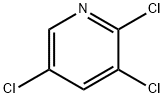 |
| | 2,3,5-Trichloropyridine Chemical Properties |
| Melting point | 46-50 °C (lit.) | | Boiling point | 219 °C (lit.) | | density | 1.539±0.06 g/cm3(Predicted) | | Fp | >230 °F | | storage temp. | under inert gas (nitrogen or Argon) at 2-8°C | | pka | -2.92±0.10(Predicted) | | form | Solid | | color | Off-white to pale yellow | | Water Solubility | Slightly soluble in water. | | BRN | 119384 | | InChI | InChI=1S/C5H2Cl3N/c6-3-1-4(7)5(8)9-2-3/h1-2H | | InChIKey | CNLIIAKAAMFCJG-UHFFFAOYSA-N | | SMILES | C1(Cl)=NC=C(Cl)C=C1Cl | | CAS DataBase Reference | 16063-70-0(CAS DataBase Reference) |
| Hazard Codes | Xi | | Risk Statements | 52/53-36/37/38 | | Safety Statements | 61-37/39-26 | | RIDADR | UN 2811 6.1/PG 3 | | WGK Germany | 2 | | RTECS | UU0525000 | | Hazard Note | Irritant | | HazardClass | 6.1 | | HS Code | 29333990 | | Storage Class | 6.1C - Combustible acute toxic Cat.3
toxic compounds or compounds which causing chronic effects | | Hazard Classifications | Acute Tox. 3 Oral
Aquatic Chronic 3
Eye Dam. 1
Skin Sens. 1 | | Toxicity | mouse,LD50,intraperitoneal,430mg/kg (430mg/kg),BEHAVIORAL: SOMNOLENCE (GENERAL DEPRESSED ACTIVITY)LIVER: FATTY LIVER DEGERATIONBEHAVIORAL: ANTIPSYCHOTIC,Toxicology and Applied Pharmacology. Vol. 11, Pg. 361, 1967. |
| | 2,3,5-Trichloropyridine Usage And Synthesis |
| Chemical Properties | Beige powder | | Uses | 2,3,5-Trichloropyridine may be used in the synthesis of 3,5-dichloro-2-arylpyridines via palladium acetate-catalyzed ligand-free Suzuki reaction with arylboronic acids. | | General Description | Separation and migration behavior of 2,3,5-trichloropyridine has been studied by micellar electrokinetic chromatography. Crystal structure of 2,3,5-trichloropyridine has been reported. Mol-ecules of 2,3,5-trichloropyridine in crystal are stacked along the short a axis and forms a layer structure. 2,3,5-Trichloropyridine is reported to undergo nucleophilic displacement reaction in ionic liquid to afford the corresponding 2-aryloxylpropionate. | | Synthesis | Add 60g methanol to 1000mL four-necked flask, put in 100g
2,3,5,6-tetrachloropyridine, 31.7g hydrazine hydrate, warming to 60-65 C, holding reaction about 2 hours, the end of the reaction, lowering the temperature to 0-5 C, stirring for 1 hour, filtration, the solid that is 2,3,5-trichloro 6-hydrazinium hydrate pyridine, drying to get a white solid 101.6g, yield 96%, content 98.5%. To a 1000 ml four-necked flask was added 100 g of
2,3,5-trichloro 6-hydrazinium hydrate pyridine, 50g content 5% sodium hydroxide aqueous solution, warming to 70 ~ 75 C, dropwise addition of 387.6g content 10% sodium hypochlorite aqueous solution, holding temperature 70 ~ 75 C, the reaction for 1 hour, the end of the reaction, lower the temperature to 5 ~ 10 C, stirring for 1 hour, filtration to obtain 2,3,5-trichloropyridine crude, distillation under reduced pressure to get the product, a light yellow Solid, yield: 95%, content: 98%. |
| | 2,3,5-Trichloropyridine Preparation Products And Raw materials |
|