|
|
| | SIDERITIFLAVONE Basic information |
| Product Name: | SIDERITIFLAVONE | | Synonyms: | 2-(3,4-Dihydroxyphenyl)-5-hydroxy-6,7,8-trimethoxy-4H-1-benzopyran-4-one;3',4',5-Trihydroxy-6,7,8-trimethoxyflavone;6,7,8-Trimethoxy-3',4',5-trihydroxyflavone;4'-O-Demethylgardenin D;2-(3,4-dihydroxyphenyl)-5-hydroxy-6,7,8-trimethoxychromen-4-one;4H-1-Benzopyran-4-one, 2-(3,4-dihydroxyphenyl)-5-hydroxy-6,7,8-trimethoxy- | | CAS: | 70360-12-2 | | MF: | C18H16O8 | | MW: | 360.31 | | EINECS: | | | Product Categories: | Hexa-substituted Flavones | | Mol File: | 70360-12-2.mol | 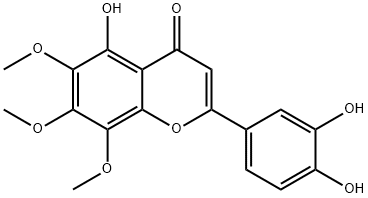 |
| | SIDERITIFLAVONE Chemical Properties |
| Melting point | 212℃ (ethanol ) | | Boiling point | 660.4±55.0 °C(Predicted) | | density | 1.461±0.06 g/cm3(Predicted) | | pka | 6.82±0.40(Predicted) |
| | SIDERITIFLAVONE Usage And Synthesis |
| Uses | Sideritoflavone is a flavonoid. Sideritoflavone can be isolated from Baccharis densiflora. Sideritoflavone is toxic to JIMT-1 breast cancer cells[1]. | | Definition | ChEBI: Sideritiflavone is a member of flavonoids and an ether. | | References | [1] Wendy Soria Sotillo, et al. Breast cancer cell line toxicity of a flavonoid isolated from Baccharis densiflora. BMC Complement Med Ther. 2021, 21, 2. DOI:10.1186/s12906-021-03349-4 |
| | SIDERITIFLAVONE Preparation Products And Raw materials |
|