Product Details
| Product Name:
FPTQ |
CAS No.:
864863-72-9 |
| Purity:
99.68% |
Supply Ability:
10g |
| Release date:
2026/04/20 |
Product Introduction
Bioactivity
| Name | FPTQ |
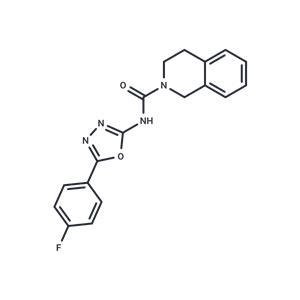
| Description | FPTQ is a highly effective antagonist of mGluR 1, displaying IC50 values of 6 nM and 1.4 nM for human and mouse mGluR1 respectively [1]. In addition to its robust inhibitory properties, FPTQ exhibits notable antioxidant and anti-inflammatory effects in both in vitro and in vivo settings [2]. |
| In vitro | FPTQ, at concentrations ranging from 0.5 to 10 μM, exhibited no cytotoxic effects in RAW264.7 macrophage cells [2]. Furthermore, when administered at doses between 1 and 20 μM for a duration of 24 hours, FPTQ significantly inhibited LPS-induced NO production starting from concentrations above 1 μM. Specifically, a 10 μM dose of FPTQ resulted in a 31% reduction in oxidative stress [2]. Additionally, this compound markedly suppressed LPS-stimulated upregulation of pro-inflammatory cytokines IL-1β and IL-6 in a concentration-dependent manner. At 10 μM, FPTQ was found to decrease the mRNA levels of IL-1β and IL-6 by 27% and 44%, respectively, illustrating its potent anti-inflammatory properties in RAW264.7 macrophage cells [2]. This was further supported by RT-PCR analysis, confirming the downregulation of these cytokines [1]. |
| In vivo | Neutrophils translocation in the zebrafish tail-transected model was inhibited by FPTQ. Neutrophil aggregation was also inhibited by FPTQ in the LPS-stimulated zebrafish model. FPTQ (5-20 μM) decreases the number of neutrophils migrating to the amputation site in zebrafish larvae by tail amputation. In the tailfin wound method, the number of neutrophils collecting at the wound site also decreases in a dose-dependent manner in zebrafish [2].In a LPS-induced inflammation zebrafish model, LPS solution is injected into the yolks of Tg(mpx:EGFP) i114 zebrafish larvae and exposed the zebrafish larvae immediately to FPTQ treatment.FPTQ (20 μM; 4 hours) significantly decreases the fluorescent neutrophils after yolk injection and has an anti-inflammatory effect during the early phase of inflammation [2]. |
| Storage | Powder: -20°C for 3 years | In solvent: -80°C for 1 year
Shipping with blue ice/Shipping at ambient temperature. |
| Solubility Information | DMSO : 4.4 mg/mL (14.41 mM), Sonication is recommended.
10% DMSO+40% PEG300+5% Tween 80+45% Saline : 1 mg/mL (3.28 mM), Sonication is recommended.
|
| Keywords | mGluR1 | FPTQ |
| Inhibitors Related | IDRA-21 | Urethane | Decanoic Acid | Kynurenic acid | DCB | L-Cysteic acid monohydrate | Evans blue | L-Glutamine | Direct Blue 1 | L-Glutamic acid monosodium salt | Memantine hydrochloride | O-Phospho-L-serine |
| Related Compound Libraries | Bioactive Compound Library | Anti-Neurodegenerative Disease Compound Library | Neuronal Signaling Compound Library | Membrane Protein-targeted Compound Library | Glutamine Metabolism Compound Library | Neurotransmitter Receptor Compound Library | Antioxidant Compound Library | Inhibitor Library | Neuroprotective Compound Library | Immunology/Inflammation Compound Library | Bioactive Compounds Library Max | Fluorochemical Library |
Company Profile Introduction
Target Molecule Corp. (TargetMol) is a global high-tech enterprise, headquartered in Boston, MA, specializing in chemical and biological research product and service to meet the research needs of global customers.
TargetMol has evolved into one of the biggest global compound library and small molecule suppliers and a customer based on 40+ countries. TargetMol offers over 80 types of compound libraries and a wide range of high-quality research chemicals including inhibitors, activator, natural compounds, peptides, inhibitory antibodies, and novel life-science kits, for laboratory and scientific use. Besides, virtual screening service is also available for customers who would like to conduct the computer-aided drug discovery.
Recommended supplier
| Product name |
Price |
|
Suppliers |
Update time |
|
|
|
|
Anhui Ruihan Technology Co., Ltd
|
2023-08-21 |



 United States