


Dimethylcarbamoyl Chloride: Reactive Acyl Chloride Intermediate
Jun 4,2026
Dimethylcarbamoyl chloride is a pale yellow, oily liquid with a pungent odor. It is soluble in organic solvents such as dichloromethane and diethyl ether. Its molecule contains an active acyl chloride group, giving it high nucleophilic reactivity. It is commonly used as an acylation intermediate in the synthesis of pharmaceuticals, pesticides, dyes, and fine chemical products.

Formation and Hydrolysis of Dimethylcarbamoyl Chloride
The Vilsmeier reaction (VR), or Vilsmeier?Haack reaction, has a large range of applications in organic synthesis. One of the most important applications is the chlorination of an alcohol. The actual chlorination reactant is the in situ generated Vilsmeier reagent, which is formed by reaction of the chlorination agent and N,N-dimethylformamide (DMF), the latter normally present in catalytic amounts. Dimethylcarbamoyl chloride, also called DMCC, is an active alkylating agent and has been used as an intermediate in the manufacture of a number of pharmaceuticals and pesticides.The formation of DMCC under VR conditions was reported as early as the 1960s. During the last five years an increased interest regarding potential genotoxic impurities (PGIs) has emerged from health authorities and the phamaceutical industry. PGIs have had such an impact that process chemists must consider changing the reagent(s), choosing another route or applying a control strategy to eliminate any PGIs. A survey of the literature revealed that there was neither a suitable analytical method nor data available for the detection of dimethylcarbamoyl chloride in a VR matrix. Matienzo and co-workers reported a direct analysis by GC for the determination of DMCC in air for as low as ppb levels by concentrating the sample on an absorbing polymer before analysis. Rusch and co-workers reported a quantitative analytical method for determination of dimethylcarbamoyl chloride in air by derivatization of the sample with 4-(p-nitrobenzyl)pyridine and spectrophotometric analysis of the derivative. Alternative analytical techniques such as LC/MS and GC/MS, without derivatization, had been investigated but suffered from corrosion problems.[1]
In the presented investigation a robust analytical procedure for measuring DMCC, using derivatisation with ethanol and GC/MS analysis in selected ion monitoring mode has been developed. The performance of the analytical method shows that it can accurately measure dimethylcarbamoyl chloride in Vilsmeier reaction mixtures down to single digit ppm levels. The analytical method enabled us to investigate the impact of some common chlorinating agents on the formation of DMCC in the Vilsmeier reaction. In all cases the amount of DMCC was low (<15 ppm), and the established order was thionyl chloride > oxalyl chloride > phosphorus oxychloride, with the latter yielding the lowest amount of dimethylcarbamoyl chloride. It was also found that, when an organic base was present in the reaction mixture, it profoundly increased the amount of DMCC formed. It has been shown that DMCC hydrolyses rapidly under aqueous workup conditions. This provides an opportunity for process chemists to design their processes in such a way that the formed dimethylcarbamoyl chloride is decreased to acceptable levels during an aqueous workup. Therefore, processes for manufacturing pharmaceuticals based upon a Vilsmeier reaction can be developed without risking the health of process operators or patients.
Lithium tetrafluoroborate in dimethylcarbamoyl chloride-based solvents
The investigations on functional organic solvents and additives with novel structures, which can provide special properties for the lithium battery electrolytes, are ongoing in our laboratory. Previously we synthesized 4-methoxymethyl ethylene carbonate (MEC) as an electrolyte solvent and studied the ion solvation and association of lithium perchlorate and tetrafluoroborate in it by vibrational spectroscopy and density functional theory. As an extension of our investigations, in this paper, ion solvation and association interactions in LiBF4/DMCC (DMCC for N,N-dimethylcarbamoyl chloride) and LiBF4/DMCC–DME (DME for 1,2-dimethoxyethane) solutions are systematically studied by vibrational spectroscopy. The DMCC is chosen as electrolyte solvent because it is structurally similar to that of DMF (N,N-dimethylformamide). In addition, due to the large electronic negativity of its chlorine atom, the DMCC solvent can provide high reduction potential on the negative electrode of a battery. The DME is used as cosolvent for its relative larger donor number (23.9) and lower viscosity (0.455 mPa s) than most of the other electrolyte solvents. Several electrolyte systems were studied by density functional theory (Gaussian 98), ranging from pure dimethylcarbamoyl chloride to solvation clusters Li+(DMCC)n. In LiBF4/DMCC–DME solution, it is found that the DME molecule interact with Li+ preferentially. This preferential solvation is supported by quantum chemistry calculations. In this paper, we are aiming at discussing the interactions between Li+ ion and solvent molecules or BF4? anions, so as to find out factors affecting the conductivity of an electrolyte.[2]
Solvation and association interactions in solutions of LiBF4/DMCC (DMCC for N,N-dimethylcarbamoyl chloride) and LiBF4/DMCC–DME (DME for 1,2-dimethoxyethane) have been studied as a function of concentration of lithium tetrafluoroborate by infrared and Raman spectroscopy. Strong interactions between Li+ and solvent molecules or BF4? anions are observed. The apparent solvation numbers of Li+ in LiBF4/DMCC solutions were deduced. Band-fitting to the B–F stretching band of BF4? anion permits detailed assess of the ion pairing. Based on the calculations of density function theory, optimal structures of Li+( dimethylcarbamoyl chloride)n (n = 1–3) were suggested. It is found that the lithium ion was preferentially solvated by DME in DMCC–DME binary solvents. This finding is supported by quantum chemistry calculations.
References
[1]Martina Stare. (2009). Investigation on the Formation and Hydrolysis of N,N-Dimethylcarbamoyl Chloride (DMCC) in Vilsmeier Reactions Using GC/MS as the Analytical Detection Method. Organic Process Research & Development, 13 5, 857–862. https://doi.org/10.1021/op900018f
[2]Hongwei Qiao . (2008). Vibrational spectroscopic and density functional theory studies on ion solvation and ion association of lithium tetrafluoroborate in N,N-dimethylcarbamoyl chloride-based solvents. Journal of Molecular Structure, 885 1, Pages 89-96. https://doi.org/10.1016/j.molstruc.2007.10.014
- Related articles
- Related Qustion


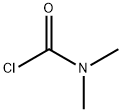
Dimethylcarbamoyl chloride
79-44-7You may like
- Lewis structure of SF5Cl, is it polar?
Jul 17, 2026
- Lewis structure of SOF4, is it polar?
Jul 17, 2026
- Lewis Structure and Molecular Properties of POF3
Jul 17, 2026
Dimethylcarbamoyl chloride manufacturers
- dimethylcarbamoyl chloride
-

- 2026-07-01
- CAS:79-44-7
- Min. Order: 20kg
- Purity: 99%
- Supply Ability: 20 tons
- Dimethylcarbamoyl chloride
-

- $8.00
- 2020-02-21
- CAS:79-44-7
- Min. Order: 1g
- Purity: >98% HPLC
- Dimethylcarbamoyl chloride
-
- $1.00
- 2019-08-30
- CAS:79-44-7
- Min. Order: 1KG
- Purity: 98%
- Supply Ability: 1kg;10kg;100kg