


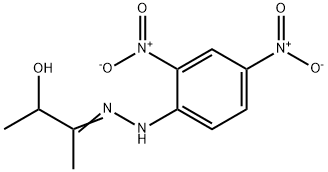
3-Hydroxy-2-butanone 2,4-dinitrophenyl hydrazone synthesis
- Product Name:3-Hydroxy-2-butanone 2,4-dinitrophenyl hydrazone
- CAS Number:35015-94-2
- Molecular formula:C10H12N4O5
- Molecular Weight:268.23

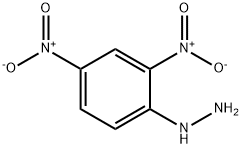
Yield:35015-94-2 99.7%
Reaction Conditions:
with hydrogenchloride in acetonitrile at 60; for 1.5 h;
Steps:
1-3
General procedure: Prepare a certain amount of 2,4-dinitrophenylhydrazine (DNPH) reagent in a beaker, add acetonitrile to dissolve it to form a DNPH supersaturated solution, transfer the upper solution to another beaker (the upper solution is the saturated DNPH solution ), add concentrated hydrochloric acid to the saturated DNPH solution (concentrated hydrochloric acid is laboratory-use concentrated hydrochloric acid, the content is between 36% and 38%), to obtain an acidic saturated 2,4-dinitrophenylhydrazine solution, acidic saturated 2, The 4-dinitrophenylhydrazine solution contains 0.005% by volume of hydrogen ions.Add 3-hydroxy-2-butanone to acetonitrile to dissolve it to prepare a 3-hydroxy-2-butanone solution, the acetonitrile contains 0.005% by volume of hydrogen ions, and put the above acidic saturated DNPH solution to a constant temperature of 60°C In the water bath, after the temperature of the acidic saturated DNPH solution reaches 60°C, add the 3-hydroxy-2-butanone solution to the acidic saturated DNPH solution. The molar ratio of the amount of 3-hydroxy-2-butanone to the amount of 2,4-dinitrophenylhydrazine is 1:1. The 3-hydroxy-2-butanone solution is added in small amounts and the solution is constantly stirred at the same time , The reaction is allowed to proceed fully, the reaction time is 1.5 hours, after the reaction is completed, the reaction solvent is completely evaporated to dryness to obtain a solid sample.Qualitative detection: Take a small amount of solid sample, dissolve it with acetonitrile and filter, and perform qualitative detection with LC-PDA (liquid chromatography and diode array detector). The wavelength used is 3-hydroxy-2-butanone-2,4- The best absorption wavelength of dinitrophenylhydrazone is 360nm. At a wavelength of 360 nm, a peak is chromatographically displayed, indicating that the target product 3-hydroxy-2-butanone-2,4-dinitrophenylhydrazone is present in the solid sample. The spectrum of 3-hydroxy-2-butanone-2,4-dinitrophenylhydrazone is shown in Figure 1.Using liquid chromatography and a diode array with a detector, at the maximum absorption wavelength of 360nm, the solid sample is dissolved in acetonitrile and filtered, DNPH and the reaction product are separated, and the reaction product is purified. The yield of the reaction product was 92%.Purity test: First configure the reaction product acetonitrile solution with a concentration of 1000ppm, and then dilute the solution to a standard working solution of 10ppm and 1ppm to be tested;Use LC-MS/MS to qualitatively confirm whether the purified material is the target, and the injection concentration is 1ppm;Connect the instrument, use the LC-PDA detector to detect the 10ppm standard working solution at 254nm, 300nm, 360nm, and use the area normalization method to calculate the purity of 3-hydroxy-2-butanone-2,4-dinitrophenylhydrazone . The chromatographic mobile phase used was acetonitrile: water = 70%: 30%, and the flow rate was 0.4 mL/min.The area normalization method to calculate the purity of the marker is shown in Table 1. The purity of 3-hydroxy-2-butanone-2,4-dinitrophenylhydrazone in the reaction product was determined to be 99.8%.
References:
CN111732523,2020,A Location in patent:Paragraph 0039-0053
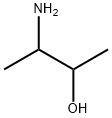
42551-55-3
30 suppliers
inquiry
35015-94-2
0 suppliers
inquiry