


?? ?
|
|
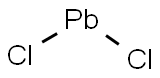
?? ? ??
- ???
- 501 °C(lit.)
- ?? ?
- 950 °C(lit.)
- ??
- 5.85 g/mL at 25 °C(lit.)
- ???
- 1 mm Hg ( 547 °C)
- ???
- 951°C
- ?? ??
- Store below +30°C.
- ???
- ??? ????: ?? ???(lit.)
- ??? ??
- ??
- ??
- ???? ?????
- Specific Gravity
- 5.85
- ???
- ??? ?, ??? ???? ? NH44Cl ??? ?????. ??? ???? ???? ????.
- Hydrolytic Sensitivity
- 0: forms stable aqueous solutions
- Crystal Structure
- PbCl2 type
- crystal system
- Nogata
- Merck
- 14,5404
- Solubility Product Constant (Ksp)
- pKsp: 4.77
- Space group
- Pnma
- Lattice constant
a/nm b/nm c/nm α/o β/o γ/o V/nm3 0.762 0.451 0.902 90 90 90 0.31
- ?? ??
- ACGIH: TWA 0.05 mg/m3
NIOSH: IDLH 100 mg/m3; TWA 0.050 mg/m3
- Dielectric constant
- 4.2(0.0℃)
- ???
- ????. ?? ???, ??? ???? ????.
- ?? ??
- ?? ?? ???
??????? ?? ??
- InChI
- 1S/2ClH.Pb/h2*1H;/q;;+2/p-2
- InChIKey
- HWSZZLVAJGOAAY-UHFFFAOYSA-L
- SMILES
- Cl[PbH2]Cl
- CAS ??????
- 7758-95-4(CAS DataBase Reference)
??
- ?? ? ?? ??
- ?? ? ???? ?? (GHS)
| ??? ?? | T,N | ||
|---|---|---|---|
| ?? ???? ?? | 61-20/22-33-50/53-62 | ||
| ????? | 53-45-60-61 | ||
| ????(UN No.) | UN 2291 6.1/PG 3 | ||
| WGK ?? | 3 | ||
| RTECS ?? | OF9450000 | ||
| TSCA | TSCA listed | ||
| ?? ?? | 6.1 | ||
| ???? | III | ||
| HS ?? | 28273990 | ||
| ???? ??? | 6.1C - Combustible acute toxic Cat.3 toxic compounds or compounds which causing chronic effects |
||
| Hazard Classifications | Acute Tox. 4 Inhalation Acute Tox. 4 Oral Aquatic Acute 1 Aquatic Chronic 1 Carc. 2 Repr. 1A STOT RE 1 |
||
| ?? ?? ??? | 7758-95-4(Hazardous Substances Data) | ||
| ?? | MLD in guinea pigs (mg/kg): 1500-2000 orally (Tartler) | ||
| ???? ?? | KE-21901 | ||
| ?????? ??? | 97-1-9 | ||
| ?????? ??? | ??1-129 | ||
| ?, ??????? ??? | 13 | ||
| ?? ? ???? | ????: ????; ???(??)????: ????(lead tetraoxide), ???(lead sulfate), ??????(basic lead carbonate)? ??? ????(Lead compounds) ? ?? 25% ?? ??? ???. ??, ???(lead acetate), ????(lead alkyls), ?????(lead azide), ????(lead di(acetate)), ??????(lead(Ⅲ) methansulfonate), ???(lead phosphate(3:2)), ?????(lead styphate)? ??? ?? 0.5% ?? ??? ??? |


?? ? C??? ??, ??, ??
??? ??
Lead chloride is a white crystalline powder??? ??
White orthorhombic crystals; refractive index 2.199; density 5.85 g/cm3; melts at 501°C; vaporizes at 950°C; partially soluble in cold water (6.73 g/L at 0°C and 9.9 g/L at 20°C); KSP 1.17x10⁻⁵ at 25°C; moderately soluble in boiling water (33.4 g/L at 100°C); slightly soluble in dilute HCl and ammonia; insoluble in alcohol.??
Lead dichloride occurs in nature as the mineral cotunnite. The compound is used in making many basic chlorides, such as Pattison’s lead white, Turner’s Patent Yellow, and Verona Yellow, used as pigments. Also, it is used as a flux for galvanizing steel; as a flame retardant in nylon wire coatings; as a cathode for seawater batteries; to remove H2S and ozone from effluent gases; as a sterilization indicator; as a polymerization catalyst for alphaolefins; and as a co-catalyst in manufacturing acrylonitrile.??
Lead(II) chloride is used in the synthesis of lead titanate and barium lead titanate ceramics; employed in the production of infrared transmitting glass and ornamental glass (aurene glass); useful as an electrode in geophysical applications and in solar cells. Analytical reagent, preparation of lead salts, as solder and flux. Pattinson's white lead, pigment in white paint, is the basic lead chloride.??
ChEBI: An inorganic chloride consisting of two chlorine atoms covalently bound to a central lead atom.?? ??
Lead dichloride is precipitated by adding hydrochloric acid or any chloride salt solution to a cold solution of lead nitrate or other lead(II) salt:Pb2+ + 2Clˉ → PbCl2
Alternatively, it is prepared by treating lead monoxide or basic lead carbonate with hydrochloric acid and allowing the precipitate to settle.
.
?? ??
Prepared by reacting lead(II) oxide /acetate or carbonate with HCl. In crystalline PbCl2, each atom is coordinated by nine Cl atoms, six of which lie at the apices of a trigonal prism and the remaining three beyond the centers of the three prism faces. Each Cl is coordinated by four or five Pb atoms. Upon exposure to air it form basic chlorides such as PbCl2.Pb(OH)2.?? ???
Lead dichloride is a weak reducing agent. Interaction of Lead dichloride and calcium is explosive on warming, [Mellor, 1941, Vol. 3, 369].???
Toxic effects from ingestion may vary from low to moderate. The oral lethal dose in guinea pigs is documented as 1,500 mg/kg. (Lewis (Sr.), R. J. 1996. Sax’s Dangerous Properties of Industrial Materials, 9th ed. New York: Van Nostrand Reinhold).????
DUST AND FUMES. POISONOUS IF INHALED. SOLID: If swallowed, may cause metallic taste, abdominal pain, vomiting, and diarrhea.????
Not flammable. POISONOUS METAL FUMES MAY BE PRODUCED IN FIRE. Toxic metal fumes. Can emit toxic metal fumes.??? ??
Used to make lead salts; lead chromate pigments; as an analytical reagent for making other chemicals; making printed circuit boards; as a solder and flux.?? ??
UN2291 Lead compounds, soluble n.o.s., Hazard Class: 6.1; Labels: 6.1-Poisonous materials, Technical Name RequiredPurification Methods
Crystallise it from distilled water at 100o (33mL/g) after filtering through sintered-glass and adding a few drops of HCl, by cooling. After three crystallisations the solid is dried under vacuum or under anhydrous HCl vapour by heating slowly to 400o. The solubility in H2O is 0.07% at ~10o, and 0.43% at ~ 100o.? ???
A reducing agent. Violent reaction with oxidizers (chlorates, nitrates, peroxides, permanganates, perchlorates, chlorine, bromine, fluorine, etc.); contact may cause fires or explosions. Keep away from alkaline materials, strong bases, strong acids, oxoacids, epoxides, and chemically active metals. Explosive with calcium 1 warming?? ? ?? ?? ? ???
???
?? ??
?? ? ?? ??
???( 358)?? ??
| ??? | ?? | ??? | ?? | ?? ? | ?? |
|---|---|---|---|---|---|
| Hebei Chuanghai Biotechnology Co., Ltd | +86-15350571055 |
Sibel@chuanghaibio.com | China | 8737 | 58 |
| Shandong Deshang Chemical Co., Ltd. | +86-0531-8875-2665 +86-13153039501 |
info@deshangchem.com | China | 659 | 58 |
| career henan chemical co | +86-0371-86658258 |
sales@coreychem.com | China | 29766 | 58 |
| CONIER CHEM AND PHARMA LIMITED | |
sales@conier.com | China | 49906 | 58 |
| Richest Group Ltd | 18017061086 |
oled@richest-group.com | CHINA | 5597 | 58 |
| SIMAGCHEM CORP | +86-5922680277 +86-13806087780 |
sale@simagchem.com | China | 17339 | 58 |
| Hefei TNJ Chemical Industry Co.,Ltd. | +86-0551-65418671 +86-189 4982 3763 |
sales@tnjchem.com | China | 34526 | 58 |
| ANHUI WITOP BIOTECH CO., LTD | +8618071025641 |
eric@witopchemical.com | China | 23506 | 58 |
| Baoji Guokang Healthchem co.,ltd | +8615604608665 15604608665 |
dominicguo@gk-bio.com | CHINA | 9389 | 58 |
| Dayang Chem (Hangzhou) Co.,Ltd. | +86-0571-88938639 17705817739 |
info@dycnchem.com | China | 52693 | 58 |