


1,3-???????
|
|
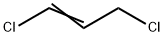
1,3-??????? ??
- ???
- -60 °C
- ?? ?
- 97-112 °C(lit.)
- ??
- 1.2
- ???
- E-isomer 3700 Pa, Z-isomer 3500 Pa at 25 °C
- ???
- n
20/D 1.472(lit.)
- ???
- 78 °F
- ?? ??
- 2-8°C
- ???
- ?????, ???? ???
- ??? ??
- liquid
- ??
- Colorless to Light yellow to Light orange
- ???
- 16.5&C?? <0.01g/100mL
- Merck
- 14,3075
- BRN
- 1719556
- Henry's Law Constant
- 6.4×10⁻³ mol/(m3Pa) at 25℃, Wright et al. (1992)
- ?? ??
- PC-TWA:4 mg/m3
- ?? ??
- ??
- InChI
- 1S/C3H4Cl2/c4-2-1-3-5/h1-2H,3H2/b2-1+
- InChIKey
- UOORRWUZONOOLO-OWOJBTEDSA-N
- SMILES
- ClC\C=C/Cl
- LogP
- 2.040
- CAS ??????
- 542-75-6(CAS DataBase Reference)
- IARC
- 2B (Vol. 41, Sup 7, 71) 1999
??
- ?? ? ?? ??
- ?? ? ???? ?? (GHS)
| ??? ?? | T,N | ||
|---|---|---|---|
| ?? ???? ?? | 10-20/21-25-36/37/38-43-50/53-65-24/25-20 | ||
| ????? | 36/37-45-60-61 | ||
| ????(UN No.) | UN 1992 3/PG 3 | ||
| OEB | B | ||
| OEL | TWA: 1 ppm (5 mg/m3) [skin] | ||
| WGK ?? | 3 | ||
| RTECS ?? | UC8310000 | ||
| TSCA | TSCA listed | ||
| ?? ?? | 3 | ||
| ???? | II | ||
| HS ?? | 29032990 | ||
| ???? ??? | 3 - Flammable liquids | ||
| Hazard Classifications | Acute Tox. 3 Dermal Acute Tox. 3 Oral Acute Tox. 4 Inhalation Aquatic Acute 1 Aquatic Chronic 1 Asp. Tox. 1 Eye Irrit. 2 Flam. Liq. 3 Skin Irrit. 2 Skin Sens. 1 STOT SE 3 |
||
| ?? ?? ??? | 542-75-6(Hazardous Substances Data) | ||
| ???? ?? | KE-05-0466 | ||
| ?????? ??? | 97-1-428 | ||
| ?? ? ???? | ????: ????; ???(??)????: 1,3-??????? ? ?? 1.0% ?? ??? ??? |


1,3-??????? C??? ??, ??, ??
??
This nematocide is used as a sol fumigant prior to crop cultivation. Mainly farmers and process operators employed at pesticide plants are exposed.??? ??
1,3-Dichloropropene is a colorless to strawcolored liquid. Sharp, sweet, irritating, chloroform-like odor.??
1,3-Dichloropropene (a technical-grade mixture of the cis-and transisomers) is used as a preplanting fumigant, mainly for the control of nematodes affecting the roots of plants, selected plant diseases, garden centipedes, wireworms, and weeds; as a solvent; and as an intermediate in the manufacture of 3,3-dichloro-1-propene and other pesticides. It is registered for use on all vegetable, fruit, and nut crops, all forage crops, tobacco, all fiber crops, and all nursery crops (EPA 1998). In Hawaii, 1,3-dichloropropene is used to control nematodes on pineapples at planting (Albrecht 1987). In 2009, three products containing 1,3-dichloropropene as an active ingredient were registered for restricted, non-residential use in the United States (EPA 2009). No products containing 1,3-dichloropropene are registered for use by homeowners (EPA 1998).?? ??
1,3-DCP is produced either by high-temperature chlorination of propylene or from 1,3-dichloro-2-propanol by dehydration with phosphoryl chloride or phosphorus pentoxide in benzene. All commercial preparations of 1,3-DCP are mixtures of the cis- and trans-isomers.According to SRI Consulting, Dow AgroSciences LLC (Freeport, Texas) is the only current manufacturer of 1,3- DCP. Active registrants of 1,3-DCP pesticide formulations include Dow AgroSciences LLC (Indianapolis, Indiana),Soil Chemicals Corporation (Hollister, California), and Trical (Hollister, California).
?? ??
A clear colorless liquid. Flash point 95°F. Denser (at 10.2 lb / gal) than water and insoluble in water. Vapors are heavier than air. Used to make other chemicals and as soil fumigant.??? ?? ??
Highly flammable. Insoluble in water.?? ???
1,3-Dichloropropene reacts vigorously with oxidizing materials. Reacts with aluminum, active metals, and halogenated compounds. Also reacts with acids and thiocyanates. Corrosive to magnesium, magnesium alloys and aluminum alloys. Incompatible with some metal salts .????
VAPOR: Irritating to eyes, nose and throat. LIQUID: Will burn skin and eyes. Harmful if swallowed.????
FLAMMABLE. POISONOUS GASES ARE PRODUCED IN FIRE. Flashback along vapor trail may occur. Vapor may explode if ignited in an enclosed area. Toxic and irritating gases may be generated.???
Soil fumigant, Nematicide: This chemical is also used in combinations with dichloropropanes as a soil fumigant to kill nematodes, insects and fungus on cotton, potatoes, tobacco, sugar beets, vegetables, grain, citrus planting sites, deciduous fruit and nut-tree planting sites, and ornamental trees and floral sites. Top four applications in California are on sweet potatoes, carrots, wine grapes and outdoor propagation nurseries. It is used on a wide variety of crops. Not approved for use in EU countries. Actively registered in the U.S.???
DURHAM NEMATOCIDE®[C]; FUMAZONE®[C]; NEMAGON®[C]; NEMEX®; PROKILL NEMATOCIDE®[C]; TELONE®; TELONE II®; TELONE II-B®; TELONE® EC DRIP; VIDDEN D®; VORLEX®?? ?? ??
This nematocide is used as a soil fumigant prior to crop cultivation. Farmers and process operators employed at pesticide plants are mainly exposedSafety Profile
Confirmed carcinogen with experimental carcinogenic data. Poison by ingestion and intraperitoneal routes. Moderately toxic by skin contact. Mildly toxic by inhalation. A strong irritant. Mutation data reported. A pesticide. A flammable liquid and dangerous fire hazard when exposed to heat, flame, or oxidzers. Reacts vigorously with oxidizing materials. To fight fire, use water, foam, CO2, dry chemical. When heated to decomposition it emits toxic fumes of Cl-. See also ALLYL COMPOUNDS and CHLORIDES.??? ??
Used as a soil fumigant prior to planting crops, such as cotton, sugar beet, potatoes; used in combinations with dichloropropanes as a soil fumigant. Workers engaged in manufacture, formulation and application of this soil fumigant and nematocide.Carcinogenicity
Technical-grade 1,3-dichloropropene (co ntaining 1.0% epichlorohydrin as a stabilizer) is reasonably anticipated to be a human carcinogen based on sufficient evidence of carcinogenicity from studies in experimental animals. The technical-grade 1,3-dichloropropene used in the cancer studies in experimental animals was a mixture of cis- and trans-isomers and varied in purity and the stabilizer used (see Properties).?? ?? ??
Degradation of 14C-1,3-dichloropropene in aerobic soils in the dark at 25℃ at concentration of approximately 100 μg g-1 results in the formation of 3-chloroallyl alchohol, 3-chloroacrylic acid, numerous minor carboxylic acid metabolites, and carbon dioxide. In addition, there is extensive incorporation of 14C labeled material into the soil organic matter in the soils. By a specific bacterium (Pseudomonas cichorii 170) which is isolated from soil, 1,3-dichloropropene is degraded in different pathways from those of soil degradation. The terminal degradate by this bacterium is acetoaldehye which undergoes mineralization.?? ??
UN2047 Dichloropropene, Hazard Class: 3; Labels: 3-Flammable liquid.? ???
Vapor may form explosive mixture with air. Incompatible with oxidizers (chlorates, nitrates, peroxides, permanganates, perchlorates, chlorine, bromine, fluorine, etc.); contact may cause fires or explosions. Keep away from alkaline materials, strong bases, strong acids, oxoacids, and epoxides. May accumulate static electrical charges, and may cause ignition of its vapors. Incompatible with strong acids; oxidizers, aluminum or magnesium compounds; aliphatic amines; alkanolamines, alkaline materials; halogens, or corrosives. Note: Epichlorohydrin may be added as a stabilizer.??? ??
Incineration, preferably after mixing with another combustible fuel. Care must be exercised to assure complete combustion to prevent the formation of phosgene. An acid scrubber is necessary to remove the halo acids produced. In accordance with 40CFR165, follow recommendations for the disposal of pesticides and pesticide containers. Must be disposed properly by following package label directions or by contacting your local or federal environmental control agency, or by contacting your regional EPA office. Consult with environmental regulatory agencies for guidance on acceptable disposal practices. Generators of waste containing this contaminant (≧100 kg/mo) must conform with EPA regulations governing storage, transportation, treatment, and waste disposal.1,3-??????? ?? ?? ? ???
???
1,2-???????
Chlorinated hydrocarbon
1.3-Dichloropropene
??(??)
?????????
N,N-?????????
????
1,1,3-????????
???????
?????
?? ??
1,3-??????? ?? ??
???( 219)?? ??
| ??? | ?? | ??? | ?? | ?? ? | ?? |
|---|---|---|---|---|---|
| Hebei Chuanghai Biotechnology Co., Ltd | +8615350571055 |
Sibel@chuanghaibio.com | China | 8738 | 58 |
| Henan Tianfu Chemical Co.,Ltd. | +86-0371-55170693 +86-19937530512 |
info@tianfuchem.com | China | 21586 | 55 |
| Hangzhou FandaChem Co.,Ltd. | 008657128800458; +8615858145714 |
FandaChem@Gmail.com | China | 1399 | 55 |
| Shenzhen Nexconn Pharmatechs Ltd | +86-755-89396905 +86-15013857715 |
admin@nexconn.com | China | 10403 | 58 |
| Shandong chuangyingchemical Co., Ltd. | 18853181302 |
sale@chuangyingchem.com | CHINA | 5906 | 58 |
| CONIER CHEM AND PHARMA LIMITED | +8618523575427 |
sales@conier.com | China | 49979 | 58 |
| career henan chemical co | +86-0371-86658258 +8613203830695 |
factory@coreychem.com | China | 29792 | 58 |
| SIMAGCHEM CORP | +86-5922680277 +86-13806087780 |
sale@simagchem.com | China | 17346 | 58 |
| Hefei TNJ Chemical Industry Co.,Ltd. | +86-0551-65418671 +8618949823763 |
sales@tnjchem.com | China | 34563 | 58 |
| AFINE CHEMICALS LIMITED | +86-571-85134551 |
info@afinechem.com | China | 15083 | 58 |