


????
|
|
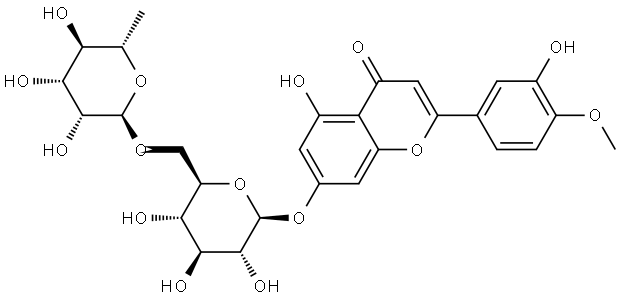
???? ??
- ???
- 277-278°C
- ?? ?
- 926.8±65.0 °C(Predicted)
- ??
- 1.68±0.1 g/cm3(Predicted)
- ???
- 0Pa at 20℃
- ?? ??
- Sealed in dry,2-8°C
- ???
- ?? ?? ?? ???, ????????? ??, ????? ?? ?? ????. ??? ????? ?? ??? ?????.
- ??? ??
- Solid
- ?? ?? (pKa)
- 6.10±0.40(Predicted)
- ??
- ??????? ?????
- ???
- DMSO(50mg/ml), ?(25°C?? 122mg/ml) ? ???(25°C?? <1mg/ml)? ?????.
- ?? ??(λmax)
- 345nm(EtOH)(lit.)
- Merck
- 14,3297
- ?? ??
- ?? ? ??
- ??? ?? ??
- ????
- InChIKey
- GZSOSUNBTXMUFQ-YFAPSIMESA-N
- SMILES
- COc1ccc(cc1O)C2=CC(=O)c3c(O)cc(O[C@@H]4O[C@H](CO[C@@H]5O[C@@H](C)[C@H](O)[C@@H](O)[C@H]5O)[C@@H](O)[C@H](O)[C@H]4O)cc3O2
- LogP
- 0.14 at 20℃
- CAS ??????
- 520-27-4(CAS DataBase Reference)
??
- ?? ? ?? ??
- ?? ? ???? ?? (GHS)
| ??? ?? | Xi | ||
|---|---|---|---|
| ?? ???? ?? | 36/37/38 | ||
| ????? | 26-36-36/37-24/25 | ||
| WGK ?? | 3 | ||
| HS ?? | 29381000 | ||
| ???? ??? | 11 - Combustible Solids | ||
| ???? ?? | KE-34297 |
| ????(GHS): |

|
|||||||||||||||||||||||||||||||||||
|---|---|---|---|---|---|---|---|---|---|---|---|---|---|---|---|---|---|---|---|---|---|---|---|---|---|---|---|---|---|---|---|---|---|---|---|---|
| ?? ?: | Warning | |||||||||||||||||||||||||||||||||||
| ??·?? ??: |
|
|||||||||||||||||||||||||||||||||||
| ??????: |
|
???? C??? ??, ??, ??
??
Diosmin was separated from the root of Scrophularia nodosa L. in 1925. The root of Scrophularia nodosa L. has the function of nourishing, reducing fever, relieving internal heat, and detoxicating. It was firstly recorded in the Shen Nong’s Classic of Materia Medica, as a class of middle-grade drug and is currently recorded in the Ch.P 2015, Volume I. The natural resource was abundant in China, mainly provided from Zhejiang, Sichuan, Hubei, Anhui, and Jiangsu provinces. In the clinical practice, Scrophularia nodosa L. was employed to eliminate pathogenic heat from the blood. In the clinical indication, diosmin was mainly applied to treat fever, polydipsia, maculitis, gingivitis, amygdalitis, laryngopharyngitis, acute lymphadenitis, etc. It also has the biological function of antiplatelet aggregation and antitumor. The chemical components include iridoids, phenylpropanoid glycoside, flavonoids, and fatty acids.??? ??
Diosmin is a natural flavonoid mainly present in the peel of some citrus fruits, such as oranges and lemons. Flavonoids are anti-inflammatory plant compounds that protect your body from free radicals and other unstable molecules. The most prevalent uses for Diosmin include hemorrhoids and leg sores caused by poor blood flow. Diosmin was first found in 1925 in the wort plant and has since been used as a natural treatment for hemorrhoids, varicose veins, venous insufficiency, leg ulcers, and other circulatory issues.??? ??
Appearance: Grayish yellow or light yellow hygroscopic powder. Solubility: Practically insoluble in water, soluble in dimethyl sulfoxide, practically insoluble in alcohol. It dissolves in dilute solutions of alkali hydroxides. Melting point: 277–278°C.??
Diosmin was firstly introduced as a medicine in 1969. It was launched in France in 1987 with the product name “Alvenor.” As the protecting agent for blood vessel and therapeutic agent for chronic venous disease, diosmin has been used for over 30years in EuropeDiosmin is a typical flavonoid. It could be prepared from natural resources or semisynthesized from the natural product hesperidin by dehydrogenation reaction.
??
Diosmin is an agonist of the aryl hydrocarbon receptor (AhR) and exhibits anti-proliferative and anti-inflammatory. It is used in the treatment of venous disease, i.e., chronic venous insufficiency (CVI) and hemorrhoidal disease (HD). Diosmin also reduces capillary hyperpermeability and expression of endothelial adhesion molecules (ICAM1, VCAM1). It effectively inhibits the P-glycoprotein (Pgp)-mediated efflux in cells.Indications
The clinical indications of diosmin are those symptoms related to venous-lymphatic dysfunction such as leg heaviness, pains, soreness, and swelling in the morning. Besides, the symptoms related to acute hemorrhoids could also be treated with diosmin.??
ChEBI: Diosmin is a disaccharide derivative that consists of diosmetin substituted by a 6-O-(alpha-L-rhamnopyranosyl)-beta-D-glucopyranosyl moiety at position 7 via a glycosidic linkage. It has a role as an antioxidant and an anti-inflammatory agent. It is a glycosyloxyflavone, a rutinoside, a disaccharide derivative, a monomethoxyflavone and a dihydroxyflavanone. It derives from a diosmetin.Pharmacology
Diosmin is a micronized, purified, flavonoid-structure drug. It is helpful for lymphatic return and stimulating microcirculation, treating hemorrhoids and venous dysfunction by increasing the venous tension.1. Increasing the venous tension. Diosmin could strengthen the tensile force of the venous wall even under high temperature. Diosmin’s action in venous constriction is stronger than other drugs like rutin. Even under the acidic toxicity in the body, it could still raise the venous tension. Diosmin has special affinity to the venous other than the arterial system.
2. Improving the microcirculation. Diosmin could effectively reduce adhesion and migration of leukocyte and vascular endothelial cells. It could also release inflammatory substances such as histamine, bradykinin, alexin, leukotriene, prostaglandin, and surplus free radicals. Hence, the penetration of capillary blood vessel was reduced, and the tension was enhanced. Besides, diosmin could decrease blood viscosity, accelerate erythrocyte flow rate, and finally reduce the chances of microcirculatory stasis
3. Stimulating the lymphatic return. Diosmin could effectively increase the speed of lymphatic drainage and the lymphatic contraction, accelerating the circumfluence of interstitial fluid, improving lymphatic return, and relieving edema.
Clinical Use
Diosmin was mainly used to treat diseases like chronic venous dysfunction, haemorrhoids, lymphedema, phlebeurysm, etc.???
Diosmin can cause some side effects such as nausea, stomach pain, diarrhea, insomnia, dizziness, headache, drowsiness, skin redness and hives, muscle pain, blood problems, and altered heart rate.There may be a few of minor gastrointestinal reactions and adverse reactions such as plant nerve function disorder, but generally mild and don't have to stop the drug.
Pregnant women and nursing mothers with hemorrhoids are safe to use this product.
Mode of action
1. Enhance the vein tension, even not exceptional under high temperature condition. It has a stronger effect causing the constriction of vein than other drugs such as rutin, still can enhance the tension of the vein when the body was acidosis. Diosmin has specific affinity for vein without affecting the arterial system.2. Improve microcirculation. Diosmin can obviously reduce the white blood cells and vascular endothelial cell adhesion, migration, disintegrating the release of inflammatory substances, such as histamine, slow excitation peptide, complement, leukotriene, prostaglandins, and too many free radicals, reducing the permeability of capillaries and enhance its tension. Diosmin can lower blood viscosity, enhance the function of red blood cell velocity, thus reduce the microcirculation clogged.
3. Promote lymphatic circumfluence. Diosmin can increase the speed of lymphatic drainage.
???? ?? ?? ? ???
???
?? ??
???? ?? ??
???( 710)?? ??
| ??? | ?? | ??? | ?? | ?? ? | ?? |
|---|---|---|---|---|---|
| Chengdu ChenLv Herb Co.,Ltd | +86-13608205856; 13608205856 |
maryextract@126.com | China | 127 | 58 |
| Hangzhou Hyper Chemicals Limited | +86-0086-57187702781 +86-13675893055 |
info@hyper-chem.com | China | 310 | 58 |
| Sinoway Industrial co., ltd. | +86-0592-5800732 +86-13806035118 |
xie@china-sinoway.com | China | 1370 | 58 |
| Shaanxi Dideu Medichem Co. Ltd | +86-17392712779 |
1097@dideu.com | China | 3992 | 58 |
| Wuhan Fortuna Chemical Co., Ltd | +86-27-59207850 |
info@fortunachem.com | China | 6001 | 58 |
| Anhui Ruihan Technology Co., Ltd | +undefined17756083858 |
daisy@anhuiruihan.com | China | 973 | 58 |
| Chongqing Zhihe Biopharmaceutical Co., Ltd. | +86-17782035140 |
sales@zhswyy.com | China | 263 | 58 |
| Henan Fengda Chemical Co., Ltd | +86-371-86557731 +86-13613820652 |
info@fdachem.com | China | 20120 | 58 |
| Shaanxi TNJONE Pharmaceutical Co., Ltd | |
sarah@tnjone.com | China | 1143 | 58 |
| BINBO BIOLOGICAL CO.,LTD | +8618629063126 |
info@binbobiological.com | China | 480 | 58 |