


2-??????
|
|
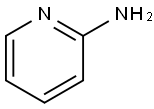
2-?????? ??
- ???
- 59 °C
- ?? ?
- 204-210 °C(lit.)
- ?? ??
- 600kg/m3
- ??
- 1.0308 (estimate)
- ???
- 5 hPa (125 °C)
- ???
- 1.5560 (estimate)
- ???
- 198 °F
- ?? ??
- Store below +30°C.
- ???
- 890g/L
- ?? ?? (pKa)
- 6.82(at 20℃)
- ??? ??
- ??? ??, ?? ?? ????
- ??
- ??~?? ???-????
- ??
- ??? ??
- ???
- ?? ???. 19ºC?? 1~5g/100mL
- ??
- Hygroscopic
- Merck
- 14,473
- BRN
- 105785
- Henry's Law Constant
- 3.9×10³ mol/(m3Pa) at 25℃, HSDB (2015)
- ?? ??
- ACGIH:TLV-TWA 0.5 ppm (1.9 mg/m3)
OSHA:PEL-TWA 0.5 ppm (2 mg/m3)
NIOSH:REL-TWA 0.5 ppm
- InChI
- 1S/C5H6N2/c6-5-3-1-2-4-7-5/h1-4H,(H2,6,7)
- InChIKey
- ICSNLGPSRYBMBD-UHFFFAOYSA-N
- SMILES
- Nc1ccccn1
- LogP
- 0.53
- CAS ??????
- 504-29-0(CAS DataBase Reference)
??
- ?? ? ?? ??
- ?? ? ???? ?? (GHS)
| ??? ?? | T,Xi | ||
|---|---|---|---|
| ?? ???? ?? | 21-25-36/37/38-23/24/25 | ||
| ????? | 26-36/37/39-45-38-28B | ||
| OEB | B | ||
| OEL | TWA: 0.5 ppm (2 mg/m3) | ||
| ????(UN No.) | UN 2671 (AMINOPYRIDINES (o-, m-, p,)) | ||
| WGK ?? | 3 | ||
| RTECS ?? | US1575000 | ||
| F ?????? | 8-21 | ||
| ?? ?? ?? | >630 °C | ||
| ?? ?? ?? | Toxic/Irritant | ||
| TSCA | TSCA listed | ||
| ?? ?? | 6.1 | ||
| ???? | II | ||
| HS ?? | 29333999 | ||
| ???? ??? | 6.1A - Combustible acute toxic Cat. 1 and 2 very toxic hazardous materials |
||
| Hazard Classifications | Acute Tox. 3 Dermal Acute Tox. 3 Oral Aquatic Chronic 3 Eye Dam. 1 Skin Corr. 1A |
||
| ?? ?? ??? | 504-29-0(Hazardous Substances Data) | ||
| ?? | LD50 orally in Rabbit: 200 mg/kg | ||
| IDLA | 5 ppm | ||
| ???? ?? | KE-29925 |


2-?????? C??? ??, ??, ??
??? ??
2-Aminopyridine is a yellow or white crystalline (sand-like) solid with a characteristic odor. It is soluble in water, alcohol, benzene, ether and hot petroleum ether. It tastes bitter and has anesthetic effect. It is a significant synthetic synthon, with unique dual nucleophilic structure. It can react with ketones, aldehydes, acids, multifunctional esters, halogenated aromatics and other compounds to synthesize five- and six-member azaheterocycles. after prolonged storage, may darken in color.??
2-Aminopyridine is used primarily in the pharmaceutical industry as an intermediate in chemical synthesis. It is used to manufacturing analgesic and anti-inflammatory drugs piroxicam and lornoxicam. 2-Aminopyridine is a basic building block of several heterocyclic compounds and Schiff bases. It has been shown to reversibly block voltage-dependent potassium channels, and is also a common impurity from the synthesis of compounds found in hair dyes. It is a derivatizing agent which can be used as a fluorescent label for oligosaccharide detection, chromatographic separation, fluorometric or mass spectrometric analysis. 2AP and its derivatives are good candidates for antimicrobial, anticorrosion and molecular sensing applications.?? ??
2-Aminopyridine has also been used to derivatize sialyloligosaccharides for detection in FAB-MS. It can also be used:As a reactant in the synthesis of 3-aroylimidazopyridines from chalcones by aerobic oxidative amidation using copper acetate catalyst.
In the synthesis of crystalline Cu(II) complex, di-μ-(2-aminopyridine(N,N′))-bis[(2,6 pyridinedicarboxylate)aquacopper(II)] tetrahydrate using 2,6-pyridinedicarboxylic acid and Cu(CH3COO)2.H2O.
As an imprinting molecule for the preparation of poly(methacrylic acid–ethylene glycol dimethacrylate) polymer. It is packed in micro-column for selective solid phase extraction of 2-aminopyridine.
As a reactant in the synthesis of 2-aryl-3-(pyridin-2-yl)-1,3-thiazolidin-4-ones in the presence of Lewis acid catalysts.
As a reactant in the synthesis of 2-(2-aminopyridinium)acetyl starch with antioxidant property.
?? ??
2-Aminopyridine is manufactured using the reaction of pyridine with sodium amide (Chichibabin amination). It is obtained in high yield after the hydrolysis of the intermediate salt (Merck, 2001; Shimizu et al., 1993).?? ??
2-aminopyridine appears as white powder or crystals or light brown solid. It is soluble in water and alcohol. It is toxic by ingestion and by inhalation of the dust. It is used to make pharmaceuticals and dyes. (NTP, 1992)??? ?? ??
Decomposes in air. Soluble in water.?? ???
2-Aminopyridine neutralizes acids in exothermic reactions to form salts plus water. May be incompatible with isocyanates, halogenated organics, peroxides, phenols (acidic), epoxides, anhydrides, and acid halides. May generate hydrogen, a flammable gas, in combination with strong reducing agents such as hydrides. Reacts with oxidizing agents .???
Toxic.????
2-Aminopyridine causes central nervous system effects.????
2-Aminopyridine is combustible.Safety Profile
Poison by ingestion, inhalation, subcutaneous, intravenous, and intraperitoneal routes. Toxic effects resemble strychnine poisoning. Human systemic effects by inhalation: somnolence, convulsions, and antipsychotic effects. Human central nervous system effects by inhalation. When heated to decomposition it emits highly toxic fumes of NOx,.??? ??
2-Aminopyridine is used in the manufacture of pharmaceuticals; especially antihistamines.Carcinogenicity
The LD50 in mice by intraperitoneal injection was 35 mg/kg; lethal doses in animals also produced excitement, tremors, convulsions and tetany.1 Fatal doses were readily absorbed through the skin. A 0.2 M aqueous solution dropped in a rabbit’s eye was only mildly irritating.2-Aminopyridine was not mutagenic in a variety of Salmonella tester strains with or without metabolic activation.
????
Soil. When radio-labeled 4-aminopyridine was incubated in moist soils (50%) under aerobic conditions at 30 °C, the amount of 14CO2 released from an acidic loam (pH 4.1) and an alkaline, loamy sand (pH 7.8) was 0.4 and 50%, respectively (Starr and Cunningham, 1975).Chemical/Physical. Releases toxic nitrogen oxides when heated to decomposition (Sax and Lewis, 1987).
?? ??
UN2671 Aminopyridines, Hazard Class: 6.1; Labels: 6.1-Poisonous materials.Purification Methods
It crystallises from *benzene/pet ether (b 40-60o) or CHCl3 /pet ether. [Beilstein 22/8 V 280.]? ???
Incompatible with oxidizers (chlorates, nitrates, peroxides, permanganates, perchlorates, chlorine, bromine, fluorine, etc.); contact may cause fires or explosions. Keep away from alkaline materials, strong bases, strong acids, oxoacids, epoxides??? ??
Incineration with nitrogen oxides removal from effluent gas.?? ??
[1] RAO R N, CHANDA K. 2-Aminopyridine – an unsung hero in drug discovery[J]. Chemical Communications, 2021, 3: 343-382. DOI:10.1039/D1CC04602K.[2] D. M. BYSTROV L. L F. Reactivity of 2-aminopyridine N-oxides[J]. Russian Chemical Bulletin, 2024, 73 1: 33-52. DOI:10.1007/s11172-024-4120-2.
[3] KUMPINA I, BASKEVICS V, WALBY G D, et al. Synthesis of 2-Aminopyridine-Modified Peptide Nucleic Acids[J]. Synlett, 2023, 25 1: 0. DOI:10.1055/a-2191-5774.
[4] MEHMET TüMER. Antimicrobial activity studies of the binuclear metal complexes derived from tridentate Schiff base ligands[J]. Transition Metal Chemistry, 1999, 24 4: 414-420. DOI:10.1023/A:1006973823926.
2-?????? ?? ?? ? ???
???
?? ??
?????
2,6-???????
2-Acetamido-5-fluoropyridine
1-(2-Pyridylazo)-2-naphthol
3-(2-Chloroethyl)-6,7,8,9-tetrahydro-2-methyl-4H-pyrido[1,2-a]pyrimidin-4-one
????
2,5-Dibromo-3-nitropyridine
Tenoxicam
2-Benzylaminopyridine
2-Fluoropyridine-5-boronic acid
2-ACETAMIDO-5-AMINOPYRIDINE
2-??????[1,2-A]???-3-?????
2-(5-???-2-?????)-5-(??????)??
2-??????
N-(3-FORMYL-2-PYRIDINYL)-2,2-DIMETHYLPROPANAMIDE
2-???-5-???????
2-Acetamido-5-nitropyridine
7-CHLORO-10-(4-HYDROXYANILINO)-2-METHOXY BENZO(B)-1,5-NAPHTHY RIDINE
??????
Lornoxicam
????[1,2-A]???-2-CARBOXYLICACID
5-(AMINOMETHYL)PYRIDIN-2-AMINE
2-??-????[1,2-A]???-3-???????????
2-Fluoro-5-iodopyridine
2-????-5-??????
?????
2-Chloro-5-nitropyridine
???-2,3,6-????
2-CHLORO-5-FLUOROISONICOTINIC ACID
IMIDAZO[1,2-A]???-2-???????????
2-Chloro-5-iodopyridine
2-??????
2-?????? ?? ??
???( 654)?? ??
| ??? | ?? | ??? | ?? | ?? ? | ?? |
|---|---|---|---|---|---|
| Hebei Chuanghai Biotechnology Co., Ltd | +86-15350571055 |
Sibel@chuanghaibio.com | China | 8738 | 58 |
| Hebei Chuanghai Biotechnology Co,.LTD | +86-86-13131129325 |
sales1@chuanghaibio.com | China | 5220 | 58 |
| Frapp's ChemicalNFTZ Co., Ltd. | +86 (576) 8169-6106 |
sales@frappschem.com | China | 880 | 50 |
| Capot Chemical Co.,Ltd. | +86-(0)57185586718 +86-13336195806 |
sales@capot.com | China | 29640 | 60 |
| Henan Tianfu Chemical Co.,Ltd. | +86-0371-55170693 +86-19937530512 |
info@tianfuchem.com | China | 21585 | 55 |
| Shanghai Time Chemicals CO., Ltd. | +86-021-57951555 +8618017249410 |
jack.li@time-chemicals.com | China | 1803 | 55 |
| ATK CHEMICAL COMPANY LIMITED | +undefined-21-51877795 |
ivan@atkchemical.com | China | 33024 | 60 |
| Speranza Chemical Co., Ltd. | +86-86-075521030354 +86-18688942810 |
sophieliu@speranzachem.com | China | 923 | 55 |
| career henan chemical co | +86-0371-86658258 |
sales@coreychem.com | China | 29812 | 58 |
| Win-Win Chemical CO., Limited | 0086-577-64498589 |
sales@win-winchemical.com | CHINA | 998 | 58 |