


????
|
|
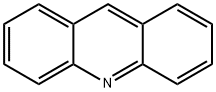
???? ??
- ???
- 106-109 °C
- ?? ?
- 346 °C(lit.)
- ??
- 1,005 g/cm3
- ???
- 1.7270 (estimate)
- ???
- 346°C
- ?? ??
- Refrigerator
- ???
- ???: 0.1 g/mL, ??
- ?? ?? (pKa)
- 5.58(at 20℃)
- ??? ??
- ??? ??
- ??
- ????? ???
- pH ??
- Green B uorescence (5.2) to violet B uorescence (6.6)
- ???
- 57.35mg/L(24℃)
- ?? ??(λmax)
- 358nm, 392nm
- Merck
- 14,122
- BRN
- 120200
- Henry's Law Constant
- 3.3×101 mol/(m3Pa) at 25℃, Mackay et al. (2006)
- ?? ??
- OSHA: TWA 0.2 mg/m3
- ???
- ????. ?? ??. ?? ???? ???? ????.
- ?? ??
- ?? ?? ????, ??????, ????, ?? ??, ??? ??, ???, ?? ?? ??, ?? ?????, ?? ?? ??, ??, ???, ??, ???, ??? ?? ???, ?? ??, ?????, ??, ???, ?HCV ?? ??, ???, ???????, ?? ??? ??, ??, ???? ? ? ??
- InChI
- 1S/C13H9N/c1-3-7-12-10(5-1)9-11-6-2-4-8-13(11)14-12/h1-9H
- InChIKey
- DZBUGLKDJFMEHC-UHFFFAOYSA-N
- SMILES
- c1ccc2nc3ccccc3cc2c1 || c1ccc2nc3ccccc3cc2c1
- LogP
- 3.400
- CAS ??????
- 260-94-6(CAS DataBase Reference)
??
- ?? ? ?? ??
- ?? ? ???? ?? (GHS)
| ??? ?? | Xn | ||
|---|---|---|---|
| ?? ???? ?? | 22-68-36/37/38 | ||
| ????? | 22-36-45-36/37/39-26 | ||
| ????(UN No.) | UN 2713 | ||
| WGK ?? | 3 | ||
| RTECS ?? | AR7175000 | ||
| TSCA | TSCA listed | ||
| ?? ?? | 6.1 | ||
| ???? | III | ||
| HS ?? | 29333990 | ||
| ???? ??? | 6.1C - Combustible acute toxic Cat.3 toxic compounds or compounds which causing chronic effects |
||
| Hazard Classifications | Acute Tox. 4 Oral Aquatic Acute 1 Aquatic Chronic 1 Eye Irrit. 2 Skin Irrit. 2 STOT SE 3 |
||
| ?? ?? ??? | 260-94-6(Hazardous Substances Data) | ||
| ?? | LD50 s.c. in mice: 0.40 g/kg (Rubbo) |


???? C??? ??, ??, ??
??? ??
colourless to light yellow crystals??
manufacture of dyes and intermediates; some dyes derived from it are used as antiseptics, e.g. 9-aminoacridine, acriflavine and proflavine. The hydrochloride has been used as reagent for cobalt, iron and zinc.??
A colorless crystalline heterocyclic compound with three fused rings. Derivatives of acridine are used as dyes and biological stains.World Health Organization (WHO)
Acridine derivatives with antiseptic and disinfectant activity, including acriflavine, proflavine and euflavine, were formerly used in the treatment of infected wounds and burns. Such use has largely been discontinued on the grounds that safer and more effective alternatives are now available. Following demonstration of the mutagenic activity of proflavine in 1978 it was withdrawn from dental products in Denmark. Subsequently, euflavine was similarly withdrawn.?? ??
Small colorless needle-like crystalline solid. Slightly soluble in hot water. Slightly denser than water. Contact may irritate skin, eyes, and mucous membranes. Sublimes before melting when heated. May be toxic by ingestion.??? ?? ??
Slightly soluble in hot water.?? ???
Acridine neutralizes acids in exothermic reactions to form salts plus water. May be incompatible with isocyanates, halogenated organics, peroxides, phenols (acidic), epoxides, anhydrides, and acid halides. Flammable gaseous hydrogen may be generated in combination with strong reducing agents, such as hydrides. Burns to give toxic oxides of nitrogen.????
Inhalation irritates respiratory system and causes sneezing, crying, and vomiting. Contact with liquid irritates eyes, skin, and mucous membranes. At high temperature and during sun exposure, damage to the cornea, skin, and mucous membranes may occur following the liberation of Acridine vapor.Safety Profile
Poison by ingestion, subcutaneous, and intravenous routes. Mutation data reported. A skin, eye, and mucous membrane irritant. When heated to decomposition it emits toxic fumes of NO,.??? ??
Acridine and its derivatives are widely used in the production of dyestuffs, such as acriflavine, benzoflavine, and chrysaniline; and in the synthesis of pharmaceuticals; such as aurinacrine, proflavine, and rivanol. A constituent of coal tar, coal tar creosote; found in wastes from gas and tar plants and coke oven emissions. Incompatibilities: Strong acids, strong oxidizers.?? ??
UN2713 Acridine, Hazard Class: 6.1; Labels: 6.1-Poisonous materialsPurification Methods
Acridine has been crystallised twice from *benzene/cyclohexane, or from aqueous EtOH, then sublimed, removing and discarding the first 25% of the sublimate. The remainder is again crystallised and sublimed, discarding the first 10-15% [Wolf & Anderson J Am Chem Soc 77 1608 1955]. Acridine can also be purified by crystallisation from n-heptane and then from ethanol/water after pre-treatment with activated charcoal, or by chromatography on alumina with pet ether in a darkened room. Alternatively, acridine can be precipitated as the hydrochloride from *benzene solution by adding HCl, after which the base is regenerated, dried at 110o/50mm, and recrystallised to constant melting point from pet ether [Cumper et al. J Chem Soc 4518 1962]. The regenerated free base may be recrystallised, chromatographed on basic alumina, then vacuum-sublimed and zone-refined. [Williams & Clarke, J Chem Soc, Faraday Trans 1 73 514 1977, Albert, The Acridines Arnold Press 1966.] It can exist in five crystalline forms and is steam volatile. It is a strong IRRITANT to skin and mucous membranes and can become a chronic irritant— handle it with CARE. [Beilstein 20/8 V 199.]? ???
Acridine and its derivatives are widely used in the production of dyestuffs, such as acriflavine, benzoflavine, and chrysaniline; and in the synthesis of pharmaceuticals; such as aurinacrine, proflavine, and rivanol. A constituent of coal tar, coal tar creosote; found in wastes from gas and tar plants and coke oven emissions. Incompatibilities: Strong acids, strong oxidizers.??? ??
Incineration with nitrogen oxide removal from the effluent gas by scrubber, catalytic, or thermal device.???? ?? ?? ? ???
???
??
N-???????
9(10H)-????
Benzaldehyde, 2-(phenylamino)-
2-?????????
10-????????-10-??
???
9-?????????
????(2-)
2,2'-???????
????????????????????
2-??????????
????
?? ??
???? ?? ??
???( 195)?? ??
| ??? | ?? | ??? | ?? | ?? ? | ?? |
|---|---|---|---|---|---|
| Hebei Chuanghai Biotechnology Co,.LTD | +86-86-13131129325 |
sales1@chuanghaibio.com | China | 5220 | 58 |
| Henan Tianfu Chemical Co.,Ltd. | +86-0371-55170693 +86-19937530512 |
info@tianfuchem.com | China | 21585 | 55 |
| career henan chemical co | +86-0371-86658258 |
sales@coreychem.com | China | 29812 | 58 |
| Zhengzhou Yuanli Biological Technology Co., Ltd | 0086-371-67897895 18903711767 |
sales02@zzyuanli.cn | CHINA | 149 | 58 |
| Patience Biological Engineering (Shanghai)Co.,Ltd. | 13818903334 |
admin@pssh.com.cn | CHINA | 2 | 58 |
| BOC Sciences | +1-631-485-4226 |
inquiry@bocsci.com | United States | 19936 | 58 |
| Hefei TNJ Chemical Industry Co.,Ltd. | +86-0551-65418671 +86-189 4982 3763 |
sales@tnjchem.com | China | 34563 | 58 |
| ANHUI WITOP BIOTECH CO., LTD | +8618071025641 |
eric@witopchemical.com | China | 23541 | 58 |
| Baoji Guokang Healthchem co.,ltd | +8615604608665 15604608665 |
dominicguo@gk-bio.com | CHINA | 9414 | 58 |
| Hefei Hirisun Pharmatech Co., Ltd | +8615056975894 |
shawn@hirisunpharm.com | CHINA | 9911 | 58 |
???? ?? ??:
C.I. ?? VI?ET 19 ??????? 3,6-???????? ????? ???? C.I. ?? ?? 24 9-??????? ???(A,J)???? ????? ???(A,H)????
3-AZETIDINECARBOXYLIC ACID, METHYL ESTER, HYDROCHLORIDE
CI 46025
9-Chloroacridine
6,9-Dichloro-2-methoxyacridine
Mepacrine hydrochloride
9-HYDROXY-4-METHOXYACRIDINE
acridine,monohydrochlorid
6,9-DIAMINO-2-ETHOXYACRIDINE LACTATE
ACRIDINE ORANGE