


??????????????
|
|
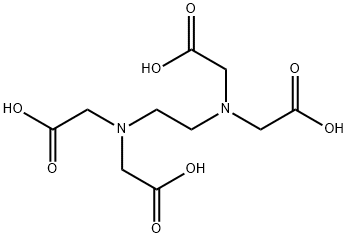
?????????????? ??
- ???
- 250 °C (dec.) (lit.)
- ?? ?
- 434.18°C (rough estimate)
- ??
- 1.46 g/cm3 at 20 °C
- ?? ??
- 600kg/m3
- ???
- <0.013 hPa (20 °C)
- ???
- n
20/D 1.363
- ???
- >400°C DIN 51758
- ?? ??
- 2-8°C
- ???
- 3 M NaOH: 100mg/mL
- ?? ?? (pKa)
- pKa 2 (Uncertain);10.26 (Uncertain)
- ??? ??
- ?? ??
- ??
- ???? ?? ??
- ??
- ?? ??
- pH ??
- 2.5 at 10 g/l at 23 °C
- ??????(pH)
- 2.5 (10g/l, H2O, 23℃)(slurry)
- ???
- 0.5g/L(25℃)
- ?? ??(λmax)
- λ: 280 nm Amax: ≤0.25
- ????
- 240 °C
- Merck
- 14,3517
- BRN
- 1716295
- ???
- ????. ??, ?? ??, ??, ????, ????, ???? ???? ????.
- ??? ?? ??
- ????
- InChI
- 1S/C10H16N2O8/c13-7(14)3-11(4-8(15)16)1-2-12(5-9(17)18)6-10(19)20/h1-6H2,(H,13,14)(H,15,16)(H,17,18)(H,19,20)
- InChIKey
- KCXVZYZYPLLWCC-UHFFFAOYSA-N
- SMILES
- OC(=O)CN(CCN(CC(O)=O)CC(O)=O)CC(O)=O
- LogP
- -0.836 (est)
- CAS ??????
- 60-00-4(CAS DataBase Reference)
??
- ?? ? ?? ??
- ?? ? ???? ?? (GHS)
| ??? ?? | Xi | ||
|---|---|---|---|
| ?? ???? ?? | 36-52/53-36/37/38-36/38 | ||
| ????? | 26-61-37/39-36 | ||
| ????(UN No.) | UN 3077 9 / PGIII | ||
| WGK ?? | 2 | ||
| RTECS ?? | AH4025000 | ||
| F ?????? | 3 | ||
| ?? ?? ?? | >200 °C | ||
| TSCA | TSCA listed | ||
| HS ?? | 2922 49 85 | ||
| ?? ?? | 9 | ||
| ???? ??? | 11 - Combustible Solids | ||
| Hazard Classifications | Eye Irrit. 2 | ||
| ?? ?? ??? | 60-00-4(Hazardous Substances Data) | ||
| ?? | LD50 orally in Rabbit: 2580 mg/kg | ||
| ???? ?? | KE-13648 |

?????????????? C??? ??, ??, ??
??
??, ??? ? ?? ?? ???? ?? ??? ??? ??? ?? ????? ??? ???, ????? ? ???? ???? ???? ?? ?? ?? ?? 240℃(??).??
EDTA? ??? ?? ??? ?? ???? ???? ???? ????. ??? ?? ?? ? ?? ???? ?????.?? ?? ?? complexing ? ?? ??? ??; ???? ? ???? ???? ???; ??? ?? ???? ?? ??? ?? ??? ??? ?? ? ??? ?; ??, ?? ? ?? ?? ? ?? ??. ?? ???? ?? ?? ??? ??? ?? ?????.??
EDTA? ????? ?????? ??, ?? EDTA? ??? ??? ??? ???? ??? ?? ?? ???? ??? ???? Ca2+??? ???? ??? ??? ???? ???? ?? ??? ? ?? ?? ????. EDTA? ? ?? ???? ?? ??? ???? ?? ????. EDTA? Pb2+??? ?? ???? ??? ??? ???? ????? ???? ??. EDTA? ? ??? ??? ??? ? ??? ???? ? ????? ??. EDTA? ???? ???? ????? ??? ?? ??? ???? ???? ?? ?? ??? ? ??. ????? ???????? DNA? ???? ??? ??? ? ?, ??? ??? ??? ???? ?? ?? ?? ??? ??? ?? ?? ??? ??? ???? EDTA? ????. EDTA? ??? ??????? ????. ??????? EDTA? ?? ?? ??? ??, ??, ?? ?? ????. EDTA? ????? ???? ??? ? ??.??
Ethylenediaminetetraacetic Acid (EDTA) is a common polydentate ligand. In EDTA, the hydrogen atoms are easily removed in solution to produce anionic EDTA4-. In its anionic form Ethylenediaminetetraacetic Acid (EDTA) has six binding atoms, two nitrogen and four oxygen.Ethylenediaminetetraacetic Acid (EDTA) binds to a metal ion at the six binding sites, wrapping itself around the metal ion, forming a very stable complex.the strong grasp of Ethylenediaminetetraacetic Acid (EDTA) on the metal ion is analogous to a crab or lobster clamping down on an object with its claw, hence the name chelation. Ethylenediaminetetraacetic Acid (EDTA) is such an effective chelating agent because it can deactivate a metal at up to six sites.
??? ??
Ethylenediaminetetraacetic acid is a solid.??
Ethylenediaminetetraacetic Acid (EDTA) was first synthesized in the early 1930s by the German chemist Ferdinand Münz working for I. G. Farben. Münz, who was looking for a substitute for citric acid to use with dye solutions in the textile industry, was the first to patent a process for Ethylenediaminetetraacetic Acid (EDTA) synthesis in Germany in 1935. Münz subsequently applied for United States patents in 1936 and 1937 (U.S. Patent Number 2130505); his method involved reacting monochloroacetic acid (C2H3ClO2) and ethylene diamine (C2H8N2). Concurrent with Münz’s work, Frederick C. Bersworth in the United States synthesized Ethylenediaminetetraacetic Acid (EDTA) using different methods that gave greater yields and made EDTA’s commercial production economically viable. Bersworth syntheses involved reacting formaldehyde, amines, and hydrogen cyanide. Bersworth and Münz obtained patents for Ethylenediaminetetraacetic Acid (EDTA) production in the 1940s (U.S. Patent Numbers 2407645 and 2461519).??
antispasmodic?? ??
Edetic acid may be prepared by the condensation of ethylenediamine with sodium monochloroacetate in the presence of sodium carbonate. An aqueous solution of the reactants is heated to about 90°C for 10 hours, then cooled, and hydrochloric acid is added to precipitate the edetic acid.Edetic acid may also be prepared by the reaction of ethylenediamine with hydrogen cyanide and formaldehyde with subsequent hydrolysis of the tetranitrile, or under alkaline conditions with continuous extraction of ammonia.
??
An organic chelating agent.?? ??
Ethylenediamine tetraacetic acid is a colorless crystalline solid. Ethylenediaminetetraacetic acid is slightly soluble in water. The primary hazard is the threat to the environment. Immediate steps should be taken to limit its spread to the environment. Ethylenediaminetetraacetic acid is used in chemical analysis, to make detergents and cleaning compounds, and for many other uses.??? ?? ??
Slightly soluble in water.???
EDTA is short for ethylenediamhetetraacetic acid, an amino polycarboxylic acid. It is a tetraprotic acid and is represented as H4Y with four carboxyl groups and two nitrogen atoms acting as ligand sites. Thus the compound is a hexadentate ligand. Ligands include ions such as Cl-, NO2-and CN- or neutral molecules like NH3 and H2O, which possess a lone pair of electrons that can be shared with a metal cation in coordinate covalent bonds.The water solubility of EDTA is very low and, therefore, its di-sodium salt Na2H2Y.2H2O is commonly used in titrations. The Y4- forms very stable, one-to-one complexes with practically every metal ion in the Periodic Table. The reactions are carried out in a neutral or alkaline medium as the complex decomposes in acidic medium.
(and hence deterioration) of the food product, (d) to increase the storage life of whole blood by removing free calcium ions (Ca2+) to inhibit clotting, and (e) for extracting trace elements, especially copper. EDTA metal complexes, such as NaFeEDTA, MnEDTA, ZnEDTA and CuEDTA are used as fertilizers and foliar sprays.
???? ??
Chelating agent; sequesters di- and trivalent metal ions.Safety Profile
Poison by intraperitoneal route. Experimental teratogenic and reproductive effects. Mutation data reported. A general-purpose chelaung and complexing agent. When heated to decomposition it emits toxic fumes of NOx.Safety
Edetic acid and edetates are widely used in topical, oral, and parenteral pharmaceutical formulations. They are also extensively used in cosmetics and food products.Edetic acid is generally regarded as an essentially nontoxic and nonirritant material, although it has been associated with doserelated bronchoconstriction when used as a preservative in nebulizer solutions. It has therefore been recommended that nebulizer solutions for bronchodilation should not contain edetic acid.
Edetates, particularly disodium edetate and edetate calcium disodium, are used in a greater number and variety of pharmaceutical formulations than the free acid.
Disodium edetate, trisodium edetate, and edetic acid readily chelate calcium and can, in large doses, cause calcium depletion (hypocalcemia) if used over an extended period or if administered too rapidly by intravenous infusion. If used in preparations for the mouth, they can also leach calcium from the teeth. In contrast, edetate calcium disodium does not chelate calcium. Edetate calcium disodium is nephrotoxic and should be used with caution in patients with renal impairment.
The WHO has set an estimated acceptable daily intake for disodium edetate in foodstuffs at up to 2.5 mg/kg body-weight.
LD50 (mouse, IP): 0.25 g/kg
LD50 (rat, IP): 0.397 g/kg
??? ??
EDTA is a white, odorless, crystalline material or white powder????
EDTA can be very persistent in water, including wastewatertreatment plants. EDTA is often found in the receiving waters of many industrial areas, thus being classified as one of the major organic pollutants discharged in waters. The available ecotoxicity data for EDTA indicate that these compounds are slow to degrade under typical environmental conditions but are not expected to bioconcentrate. EDTA compounds range from practically nontoxic to moderately toxic on an acute basis, depending on the salt. Algae and invertebrates are among the most sensitive species based on predictive modeling for acute and chronic endpoints for EDTA, depending on the compound. EDTA and its salts also do not appear to be very toxic for terrestrial wild mammals, and adverse effects from reasonably expected agricultural uses are not expected.??
Although edetic acid is fairly stable in the solid state, edetate salts are more stable than the free acid, which decarboxylates if heated above 150°C. Disodium edetate dihydrate loses water of crystallization when heated to 120°C. Edetate calcium disodium is slightly hygroscopic and should be protected from moisture.Aqueous solutions of edetic acid or edetate salts may be sterilized by autoclaving, and should be stored in an alkali-free container.
Edetic acid and edetates should be stored in well-closed containers in a cool, dry place.
?? ??
UN3082 Environmentally hazardous substances, liquid, n.o.s., Hazard class: 9; Labels: 9-Miscellaneous hazardous material, Technical Name RequiredPurification Methods
Dissolve EDTA in aqueous KOH or ammonium hydroxide, and precipitate it twice with dilute HCl or HNO3. Boil it twice with distilled water to remove mineral acid, then recrystallise it from water or dimethylformamide. Dry it at 110o. It also recrystallises from boiling 1N HCl; wash the crystals with distilled H2O and dry them in vacuo. [Ma & Ray Biochemistry 19 751 1980, Beilstein 4 IV 2449.]? ???
Incompatible with oxidizers (chlorates, nitrates, peroxides, permanganates, perchlorates, chlorine, bromine, fluorine, etc.); contact may cause fires or explosions. Keep away from alkaline materials, strong bases, strong acids, oxoacids, epoxides, copper, copper alloys, and nickelRegulatory Status
Included in the FDA Inactive Ingredients Database (oral, otic, rectal, and topical preparations; submucosal injection preparations). Included in nonparenteral medicines licensed in the UK. Included in the Canadian List of Acceptable Non-medicinal Ingredients.?????????????? ?? ?? ? ???
???
Concentrated hydrochloric acid
??????
???????
formaldehyde
??????
????
Ethylenediamine aqueous solution
Cyanide, Quant Test Strips
?????????????,???????(2???)
???? ???
?????
??
Sodium edetate
????
??????
Activated carbon,decolor
????
??
?? ????????
?? ??
?????????????? ?? ??
???( 1462)?? ??
| ??? | ?? | ??? | ?? | ?? ? | ?? |
|---|---|---|---|---|---|
| Jiangsu Boquan Biotechnology Co., Ltd. | +86-18168774353 |
boquanshengwu003@boquansw.com | China | 248 | 58 |
| DONBOO AMINO ACID COMPANY | 13063595538 |
donboo@donboo.com | China | 9363 | 58 |
| ZHENGZHOU JIUYI TIME NEW MATERIALS CO,.LTD | +86-15225627621 +86-13213167925 |
jiuyitime@fdachem.com | China | 16511 | 58 |
| Watson Biotechnology Co.,Ltd | +86-18186686046 |
sales01@watsonbiotech.cn | China | 5731 | 58 |
| Hebei Chuanghai Biotechnology Co., Ltd | +86-15350571055 |
Sibel@chuanghaibio.com | China | 8738 | 58 |
| Hebei Yanxi Chemical Co., Ltd. | +86-17531190177 |
faithe@yan-xi.com | China | 5853 | 58 |
| Shanghai UCHEM Inc. | +86-18930848214 +86-021-56762820 |
sales@myuchem.com | China | 8873 | 58 |
| Hebei Chuanghai Biotechnology Co,.LTD | +86-86-13131129325 |
sales1@chuanghaibio.com | China | 5220 | 58 |
| Hebei Dangtong Import and export Co LTD | +86-86-4001020630 +86-13910575315 |
admin@hbdangtong.com | China | 1000 | 58 |
| Hebei Chuanghai Biotechnology Co., Ltd | +86-17732866630 |
mina@chuanghaibio.com | China | 18126 | 58 |