


Cefepime
|
|
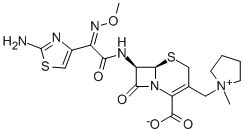
Cefepime ??
- ???
- 150 C
- ??? ??
- Solid
- ??
- White to light yellow
- InChIKey
- HVFLCNVBZFFHBT-IZVURRFBNA-N
- SMILES
- N12C([C@@H](NC(=O)/C(=N\OC)/C3N=C(N)SC=3)[C@H]1SCC(C[N+]1(C)CCCC1)=C2C([O-])=O)=O |&1:2,16,r|
- CAS ??????
- 88040-23-7(CAS DataBase Reference)
??
- ?? ? ?? ??
- ?? ? ???? ?? (GHS)
| ??? ?? | Xi | ||
|---|---|---|---|
| ?? ???? ?? | 36/37/38-42/43 | ||
| ????? | 22-26-36/37/39 | ||
| HS ?? | 29419000 |
| ????(GHS): |

|
||||||||||||||
|---|---|---|---|---|---|---|---|---|---|---|---|---|---|---|---|
| ?? ?: | Warning | ||||||||||||||
| ??·?? ??: |
|
||||||||||||||
| ??????: |
|
Cefepime C??? ??, ??, ??
??
Cefepime is a new fourth-generation parenteral cephalosporine antibiotic launched in 1993 in Sweden and France. Cefepime has broad spectrum antimicrobial activity against Staphylococcus, Strepfococcus, Pseudomonas, and the Enterobacteriaceae, including many bacterial isolates that are resistant to commonly used ceftazidime and cefotaxime. Its efficacy has been demonstrated in the treatment of lower respiratory tract infections especially pneumonia, intra-abdominal and urinary tract infections, skin and soft tissue infections, chronic osteomyelitis and in prophylaxis of biliary tract and prostate infections. It is well tolerated by patients and is reported to exhibit no significant drug interactions.??? ??
colorless Powder??
Cefepime is used for bacterial infections caused by microorganisms that are sensitive to drugs in septicemia, bacteriemia, complicated infections of the upper and lower sections of the urinary system, pneumonia, pulmonary abscesses, emphysema of the pleura, fever in patients with neutropenia, and infected skin and soft tissue wounds. Synonyms of this drug are maxipime, cepim, cepimex, and others.Antimicrobial activity
Its activity against common pathogens is comparable to that of group 4 cephalosporins, but it is somewhat more active against Ps. aeruginosa. Like cefpirome it has low affinity for the molecular class C cephalosporinases of many Gram-negative rods and is consequently active against most strains of Citrobacter spp., Enterobacter spp., Serratia spp. and Ps. aeruginosa that are resistant to cefotaxime and ceftazidime. It has poor activity against L. monocytogenes and against anaerobic organisms.Pharmacokinetics
Cmax 2 g intravenous (30-min infusion): c. 160 mg/L end infusionPlasma half-life: c. 2 h
Volume of distribution: 14–20 L
Plasma protein binding: 10–19%
It is well distributed. Penetration into tissues, including lung, appears to be similar to that of other aminothiazoyl cephalosporins. Very low concentrations are achieved in CSF in the absence of meningeal inflammation. It is secreted in breast milk.
It is partially metabolized, but 85% of the dose is excreted unchanged in the urine, achieving a concentration approaching 1 g/L within 4 h of a 1 g intravenous dose. Dosage adjustment is required in patients with impaired renal function, but hepatic impairment does not affect the pharmacokinetic properties.
Clinical Use
Cefepime (Maxipime, Axepin) is a parenteral, β-lactamase–resistant cephalosporin that is chemically and microbiologicallysimilar to cefpirome. It also has a broadantibacterial spectrum, with significant activity against bothGram-positive and Gram-negative bacteria, including streptococci,staphylococci, Pseudomonas spp., and theEnterobacteriaceae. It is active against some bacterial isolatesthat are resistant to ceftazidime. The efficacy of cefepimehas been demonstrated in the treatment of urinary tract infections,lower respiratory tract infections, skin and soft tissueinfections, chronic osteomyelitis, and intra-abdominal andbiliary infections. It is excreted in the urine with a half-life of2.1 hours. It is bound minimally to plasma proteins. Cefepimeis also a fourth-generation cephalosporin.???
It is used in the treatment of serious infections, particularly those in which resistant Gram-negative pathogens are known or suspected to be involved.Cefepime ?? ?? ? ???
???
?? ??
Cefepime ?? ??
???( 220)?? ??
| ??? | ?? | ??? | ?? | ?? ? | ?? |
|---|---|---|---|---|---|
| Wuhan Jingkang en Biomedical Technology Co., Ltd | +8613720134139 |
orders@jknbiochem.com | China | 5221 | 58 |
| Hebei Chuanghai Biotechnology Co., Ltd | +8615350571055 |
Sibel@chuanghaibio.com | China | 8738 | 58 |
| Shaanxi TNJONE Pharmaceutical Co., Ltd | +8618092446649 |
sarah@tnjone.com | China | 1143 | 58 |
| Shaanxi Xianhe Biotech Co., Ltd | +86-17709210191; +8617709210191 |
Jerry@xhobio.com | China | 906 | 58 |
| Henan Tianfu Chemical Co.,Ltd. | +86-0371-55170693 +86-19937530512 |
info@tianfuchem.com | China | 21586 | 55 |
| Biochempartner | 0086-13720134139 |
candy@biochempartner.com | CHINA | 965 | 58 |
| Accela ChemBio Inc. | +1-858-6993322 |
info@accelachem.com | United States | 21193 | 58 |
| CONIER CHEM AND PHARMA LIMITED | +8618523575427 |
sales@conier.com | China | 49979 | 58 |
| career henan chemical co | +86-0371-86658258 +8613203830695 |
factory@coreychem.com | China | 29792 | 58 |
| TargetMol Chemicals Inc. | +1-781-999-5354; +17819995354 |
marketing@targetmol.com | United States | 32467 | 58 |
Cefepime ?? ??:
N,N-????????? ??????? ??????????? ??? P-???? 2-????????? ?????????? ??????? ??????????
CEFEPIME DIHYDROCHLORIDE MONOHYDRATE
Cefetamet hydrochloride
Ceftizoxime
CEFEPIME SULFATE
2,6-Dichloropurine
Cefepime hydrochloride
Cefeprime dihydrochloride
2-(2-AMINO-THIAZOL-4-YL)-ACETAMIDE
2-(2-AMINOTHIAZOL-4-YL)ETHYLAMINE