


α-???
|
|
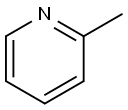
α-??? ??
- ???
- -70 °C (lit.)
- ?? ?
- 128-129 °C (lit.)
- ??
- 0.942-0.946 at 20 °C 0.943 g/mL at 25 °C (lit.)
- ?? ??
- 3.2 (vs air)
- ???
- 10 mm Hg ( 24.4 °C)
- ???
- n
20/D 1.500(lit.)
- ???
- 79 °F
- ?? ??
- Store below +30°C.
- ???
- H2O: ???? ???
- ?? ?? (pKa)
- 5.97(at 20℃)
- ??? ??
- ??
- ??
- ?? ?? ???
- ??????(pH)
- 8.5 (100g/l, H2O, 20℃)
- ??
- ??? ??
- ????
- 1.4-8.6%(V)
- ?? ??
- ??
- ???
- ?? ??
- ??
- Cp(liquid): 1.7 J/(g·K), at 25℃
- ??
- Hygroscopic
- Merck
- 14,7400
- BRN
- 104581
- Henry's Law Constant
- 9.8×10⁻¹ mol/(m3Pa) at 25℃, Brockbank (2013)
- Dielectric constant
- 9.8000000000000007
- ???
- ????. ???. ?? ???, ??, ?, ??, ???(II), ?????? ???? ????. ???.
- InChI
- 1S/C6H7N/c1-6-4-2-3-5-7-6/h2-5H,1H3
- InChIKey
- BSKHPKMHTQYZBB-UHFFFAOYSA-N
- SMILES
- Cc1ccccn1
- LogP
- 1.11 at 20℃
- CAS ??????
- 109-06-8(CAS DataBase Reference)
??
- ?? ? ?? ??
- ?? ? ???? ?? (GHS)
| ??? ?? | Xn,T | ||
|---|---|---|---|
| ?? ???? ?? | 10-20/21/22-36/37-24-20/22 | ||
| ????? | 26-36-45-36/37 | ||
| ????(UN No.) | UN 2313 3/PG 3 | ||
| WGK ?? | 1 | ||
| RTECS ?? | TJ4900000 | ||
| ?? ?? ?? | 995 °F | ||
| TSCA | TSCA listed | ||
| ?? ?? | 3 | ||
| ???? | III | ||
| HS ?? | 29333999 | ||
| ???? ??? | 3 - Flammable liquids | ||
| Hazard Classifications | Acute Tox. 3 Dermal Acute Tox. 4 Inhalation Acute Tox. 4 Oral Eye Dam. 1 Flam. Liq. 3 Skin Corr. 1C STOT SE 3 |
||
| ?? ?? ??? | 109-06-8(Hazardous Substances Data) | ||
| ?? | LD50 orally in rats: 1.41 g/kg (Smyth) | ||
| ???? ?? | KE-25315 |


α-??? C??? ??, ??, ??
??? ??
colourless to yellow liquid with an unpleasant smell??
2-Methylpyridine is released in atmospheric emissions from coal during processing into tar, pitch and coke (Windholz et al 1983; Naizer and Mashek 1974). It is also a byproduct of coal gasification and liquefaction processes (Pellizzori et al 1979; Stuermer et al 1982) and oil shale retorting (Pellizzari et al 1979). It is present in coal and is released in stack emissions (Opresko 1982). 2-Methylpyridine has been identified in effluences from the following industries: timber products, organic chemicals, pharmaceuticals and public waste treatment facilities (Schackleford and Cline 1983). 2-Methylpyridine also is a constituent of tobacco smoke (Brunneman 1978).2-Methylpyridine is biodegradable. A 1 mM solution of 2-methylpyridine exposed in soil microorganism was completely degraded in 14-33 d under aerobic conditions, but not degraded after 97 d in anaerobic conditions (Naik et al 1972).
??
2-Picoline is used as an intermediate in agrochemicals and pharmaceuticals. It serves as a solvent as well as to prepare dyes and resins. It finds application as a constituent in cigarette smoke, bone oil, coal tar and coke oven emissions. Further, it acts as a precursor of 2-vinylpyridine, picolinic acid and nitrapyrin. It is also employed to study the electron and proton transfer reactions of lumiflavin. In addition, it is used in the synthetic pathway for the preparation of dearomatized, allylated and carbon-hydrogen bond activated pyridine derivatives.?? ??
2-Methylpyridine is synthesized by distillation of coal tar or bone oil or by vapor phase reaction of acetaldehyde and ammonia in a 3:1 ratio followed by isolation of 2-methylpyridine from the reaction mixture (Considine 1974). It also can be synthesized from cyclohexylamine with excess ammonia and ZnCl2 at 350°C, resulting in a 40-50% yield; or prepared from ethylene-mercuric acetate adduct with ammonia water with a 70% yield (Windholz et al 1983). Production in 1977 probably exceeded one million pounds (Opresko 1982).?? ??
Colorless liquid with a strong, unpleasant odor. Floats on water. Poisonous vapor is produced.??? ?? ??
Highly flammable. Water soluble.?? ???
2-Picoline is hygroscopic. 2-Picoline reacts with hydrogen peroxide, iron(II) sulfate, sulfuric acid, oxidizing agents, acids, and metals.????
INHALATION, INGESTION OR SKIN ABSORPTION: Narcosis, headache, nausea, giddiness, vomiting. EYES: Severe irritation. SKIN: Causes burns. INGESTION: Irritation and gastric upset.?? ??
2-Methylpyridine is used as a solvent, or as a chemical intermediate in the dye and resin industries (Windholz et al 1983) or for pharmaceuticals and rubber (Hawley 1981). It is used to make 2-vinylpyridine which is in turn made into a terpolymer with styrene and butadiene. The latexes of these terpolymers are extensively employed in adhesives for bonding textiles to elastomers (Reinhart and Britelli 1981). It is also a chemical intermediate for 2-chloro-6-(trichloromethyl)pyridine and 2-vinylpyridine.Safety Profile
Poison by intraperitoneal route. Moderately toxic by ingestion and skin contact. Mildly toxic by inhalation. A skin and severe eye irritant. Mutation data reported. Flammable liquid when exposed to heat or flame. To fight fire, use CO2, dry chemical. Mixtures with hydrogen peroxide + iron(II) sulfate + sulfuric acid may igmte and then explode. When heated to decomposition it emits toxic fumes of NOx.??? ??
(o-isomer); Suspected reprotoxic hazard, Primary irritant (w/o allergic reaction), (m-isomer): Possible risk of forming tumors, Primary irritant (w/o allergic reaction). Picolines are used as intermediates in pharmaceutical manufacture, pesticide manufacture; and in the manufacture of dyes and rubber chemicals. It is also used as a solvent.Carcinogenicity
No reliable studies in mammals to evaluate the carcinogenic potential of any of the three methylpyridines were found. None of the methylpyridines is listed as a carcinogen by IARC, NTP, OSHA, or ACGIH.?? ??
Methylpyridines are absorbed by inhalation, ingestion or percutaneous absorption (Parmeggiana 1983). 2-Methylpyridine was rapidly absorbed and penetrated to the liver, heart, spleen, lungs and muscle during the first 10-20 min following oral administration of 0.5 g/kg to rats (Kupor 1972). The percentage uptake of 2-methylpyridine by rats increased with dosage and its elimination occurred in two phases which also were dose dependent (Zharikov and Titov 1982).Data on the biotransformation of 2-methylpyridine have been summarized by Williams (1959) and DeBruin (1976). In rabbits and dogs, the compound is oxidized to α-picolinic acid and then conjugated with glycine to form α-picolinuric acid which is excreted in the urine. In hens, it is excreted partially as α-pyridinornithuric acid. About 96% of a 100 mg/kg oral dose of 2-methylpyridine in rats was excreted in the urine as picolinuric acid (Hawksworth and Scheline 1975). There also is evidence that 2-methylpyridine forms an 2-methylated derivative in dogs (Williams 1959). Since 3-methylpyridine is converted to its N-oxide in various species (Gorrod and Damani 1980), it is likely that 2-methyl-pyridine also is similarly oxidized.
?? ??
UN2313 Picolines, Hazard Class: 3; Labels: 3-Flammable liquid.Purification Methods
Biddiscombe and Handley [J Chem Soc 1957 1954] steam distilled a boiling solution of the base in 1.2 equivalents of 20% H2SO4 until about 10% of the base had been carried over, along with non-basic impurities. Excess aqueous NaOH is then added to the residue, the free base is separated, dried with solid NaOH and fractionally distilled. 2-Methylpyridine can also be dried with BaO, CaO, CaH2, LiAlH4, sodium or Linde type 5A molecular sieves. An alternative purification is via the ZnCl2 adduct, which is formed by adding 2-methylpyridine (90mL) to a solution of anhydrous ZnCl2 (168g) and 42mL conc HCl in absolute EtOH (200mL). Crystals of the complex are filtered off, recrystallised twice from absolute EtOH (to give m 118.5-119.5o), and the free base is liberated by addition of excess aqueous NaOH. It is steam distilled, and solid NaOH is added to the distillate to form two layers, the upper one of which is then dried with KOH pellets, stored for several days with BaO and fractionally distilled. Instead of ZnCl2, HgCl2 (430g in 2.4L of hot water) can be used. The complex, which separates on cooling, can be dried at 110o and recrystallised from 1% HCl (to m 156-157o). The hydrochloride has m 78-79o, and the picrate has m 165.5o(from EtOH) and 180o(from H2O). [Beilstein 20 III/IV 2679, 20/5 V 464.]? ???
Vapors may form explosive mixture with air. Incompatible with oxidizers (chlorates, nitrates, peroxides, permanganates, perchlorates, chlorine, bromine, fluorine, etc.); contact may cause fires or explosions. Keep away from alkaline materials, strong bases, strong acids, oxoacids, epoxides. Attacks copper and its alloys.α-??? ?? ?? ? ???
???
?? ??
Ibudilast
2-????????????
Chloramphenicol palmitate
???[[(6-??-2-???)???]???]?????
??4-????-7-??-1,8-?????-3-???????
2-(2-???)?????
????
2-(2-????)-1,3-?????
4-METHOXYPYRIDINE-2-CARBOXYLIC ACID
4-Bromopyridine-2-carboxylic acid
2-Amino-6-methylpyridine
Betahistine
12-????????????97
A,A'-????
2-(Chloromethyl)pyridine hydrochloride
PYRIPROPANOL
2-(Bromomethyl)pyridine hydrobromide
BENZAMIDE, 4-METHOXY-N-[2-[2-(1-METHYL-2-PIPERIDINYL)ETHYL]PHENYL]-
2-Pyridinepropanol
2-?????? ?????
5-Amino-2-methylpyridine
2-(4-?????)???
4-Chloropyridine-2-carboxylic acid
4-Hydroxypyridine-2-carboxylic acid
2-Methylisonicotinic acid
????? ???
4-NITROPICOLINIC ACID
???????????
5-HYDROXYPYRIDINE-2-CARBOXYLIC ACID
α-??? ?? ??
???( 482)?? ??
| ??? | ?? | ??? | ?? | ?? ? | ?? |
|---|---|---|---|---|---|
| Hebei Chuanghai Biotechnology Co., Ltd | +86-15350571055 |
Sibel@chuanghaibio.com | China | 8737 | 58 |
| Hebei Yanxi Chemical Co., Ltd. | +86-17531190177 |
faithe@yan-xi.com | China | 5838 | 58 |
| Hebei Chuanghai Biotechnology Co,.LTD | +86-86-13131129325 |
sales1@chuanghaibio.com | China | 5218 | 58 |
| Hebei Chuanghai Biotechnology Co., Ltd | +86-17732866630 |
mina@chuanghaibio.com | China | 18114 | 58 |
| Capot Chemical Co.,Ltd. | +86-(0)57185586718 +86-13336195806 |
sales@capot.com | China | 29626 | 60 |
| Henan Tianfu Chemical Co.,Ltd. | +86-0371-55170693 +86-19937530512 |
info@tianfuchem.com | China | 21531 | 55 |
| Shanghai Time Chemicals CO., Ltd. | +86-021-57951555 +8618017249410 |
jack.li@time-chemicals.com | China | 1796 | 55 |
| career henan chemical co | +86-0371-86658258 |
sales@coreychem.com | China | 29766 | 58 |
| Xiamen AmoyChem Co., Ltd | +86-86-5926051114 |
sales@amoychem.com | China | 6361 | 58 |
| Shandong chuangyingchemical Co., Ltd. | 18853181302 |
sale@chuangyingchem.com | CHINA | 5898 | 58 |